Starship Flight 15 booster aborts tower catch over guidance glitch, ship catch still planned
Booster 22 sensed a navigation problem late in its descent and destroyed itself over the Gulf. SpaceX still plans to catch the upper stage at Starbase on Saturday.
 By Meera Joshi
· 5 min read
Key Takeaways
- Super Heavy Booster 22 aborted its tower catch after detecting a guidance, navigation and control fault, then was destroyed just above the Gulf of Mexico.
- The Ship upper stage passed a heat shield review and is scheduled for a first-ever tower catch at about 4:20 p.m. EST Saturday.
- A final go/no-go check around 2 p.m. EST will decide between a Starbase landing and an early splashdown off Hawaii.
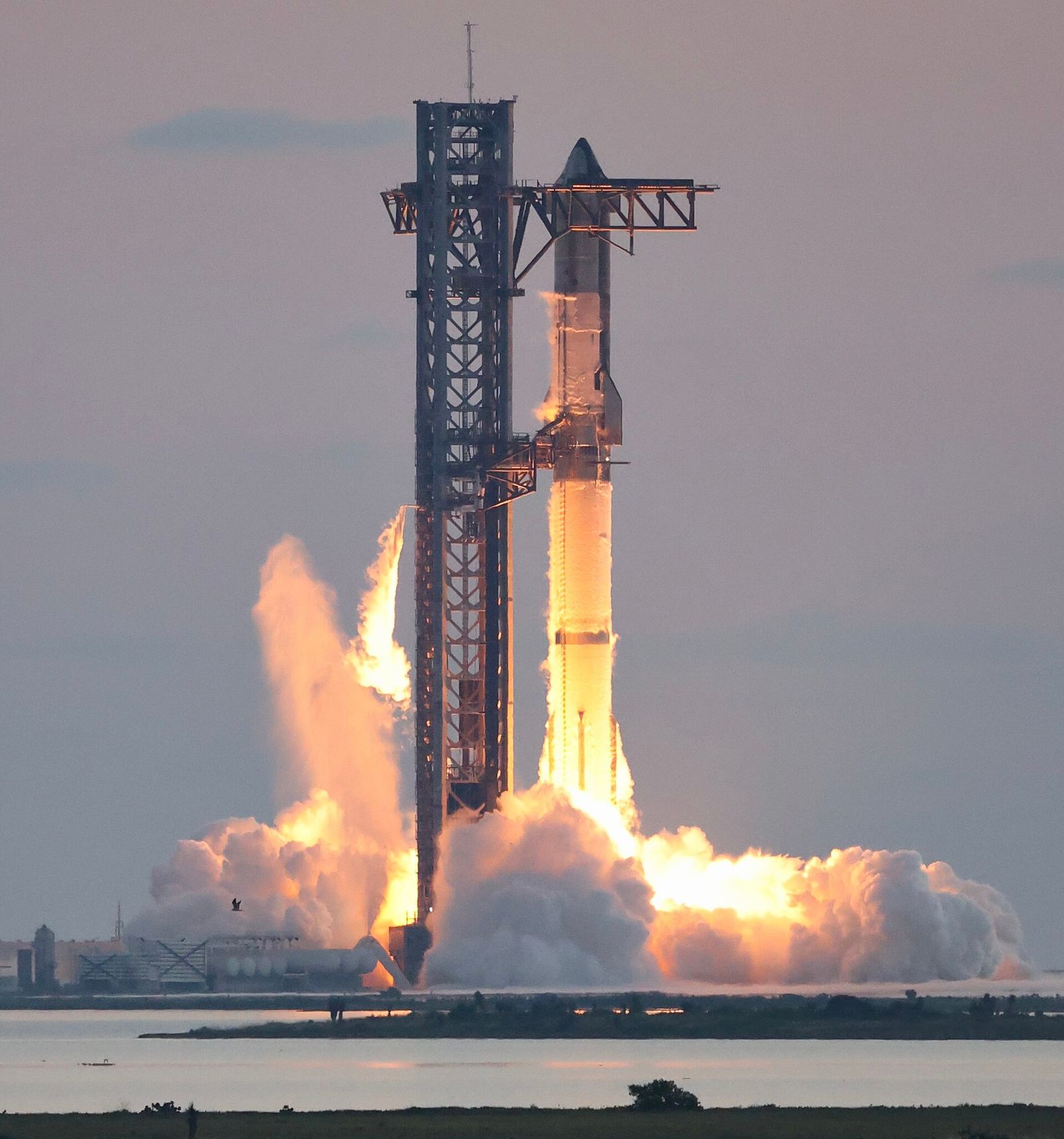
SpaceX's attempt at the first complete recovery of an orbital rocket ended on its first leg. The Super Heavy booster on Starship Flight 15 detected a problem with its guidance, navigation and control system as it came home Friday, called off its tower catch and steered out over the Gulf of Mexico, where its flight termination system destroyed it.
The rocket's upper stage is still in orbit and in good shape, the company said. A catch of that Ship by the launch tower's mechanical arms, which SpaceX has never tried, remains on the schedule for Saturday afternoon. That is now the mission's main test.
Spokesperson Dan Huot described the booster's abort during SpaceX's live commentary about seven hours into the flight. "We were initially 'go' for a catch," he said. He added that the booster flagged the fault itself late in its coast and switched to a contingency landing offshore.
How Booster 22 came apart
Starship lifted off Friday, Nov. 13, from Starbase in South Texas. Flight 15 was meant to bring both stages back to the tower and catch them in the "chopstick" arms. No orbital launch system has ever been fully recovered that way.
Booster 22 had a clean ascent. All 33 Raptor engines fired as planned, Huot said. One engine shut down after stage separation, when the booster flipped around for the boostback burn that points it back toward the launch site. "We had 32 out of the 33 booster engines lit for boostback," Huot said.
The fault appears to have come during the landing burn. In that phase the booster lights 13 engines to brake on its approach to the tower and then shuts them down in steps. SpaceX's launch video shows the 13 engines starting, then the abort and the booster turning toward its offshore contingency zone. Huot said the vehicle hovered, cut its engines, and then the termination system fired. The booster blew up a few feet above the water about 6.5 minutes after liftoff.
Losing a booster is expensive, but this sequence is the one SpaceX built the system to follow. A guidance system tells the vehicle where it is and where it is heading. When those answers can't be trusted, a 41-story rocket should not be flying toward its own launch tower and the inhabited area around Starbase. Booster 22 noticed its own problem, chose the safe option and removed itself over open water. That failure mode is far better than a catch attempt on bad data.
The open question is what caused the GNC fault. SpaceX has caught Super Heavy boosters on three earlier test flights, so returning to the tower is not new for the company. A guidance problem on a well-practiced maneuver needs a clear explanation before Flight 16. SpaceX has not said whether the earlier engine shutdown had anything to do with it, and nothing in its comments so far links the two.
The Ship's first try at a tower landing
Saturday's catch is the more ambitious goal. SpaceX has caught boosters before but has never tried to snag an upper stage returning from orbit. That stage enters the atmosphere at orbital speed and has to survive reentry before it can line up with the tower.
Flight controllers have passed several checkpoints. About seven hours after liftoff, they chose to skip an early-exit window that would have ended the mission with a splashdown off Chile. "Starship's going to stay in space. We are one step closer to an eventual return to launch site," Huot said at the time.
The heat shield review drew on an unusual source. Flight 15 carried 26 of SpaceX's next-generation Starlink V3 satellites, and some of them had cameras that photographed the Ship's thermal tiles after release. Engineers combined those images with footage from ground tracking cameras. Huot said the heat shield team confirmed it was "in a good posture for a reentry and return to the launch site."
That is a clever use of a deployment mission. Tile damage has been a recurring worry for Starship, and pictures of the vehicle's actual condition beat waiting to find out during reentry. Still, a picture of the tiles doesn't prove the stage can reenter and land precisely. The booster's abort shows that a vehicle can look fine and still fail its own last-minute checks.
The Ship will circle Earth 14 times before heading home. One more decision remains. At the mission's 20-hour mark, expected around 2 p.m. EST, controllers will choose between landing at Starbase and an "early return" splashdown off Hawaii. If they approve the landing, the catch is set for about 4:20 p.m. EST (3:20 p.m. Texas time), roughly 22.5 hours after liftoff. SpaceX has said it will cancel the catch if it sees anything abnormal with the Ship, just as the booster called off its own attempt.
Why the double catch matters to SpaceX
Flight 15 is only the second Starship mission to put the Ship into orbit. The first was Flight 14, launched Sept. 28, which also released 26 Starlink V3 satellites. Those 52 spacecraft are the first of a planned constellation of 100,000, according to SpaceX. Its current Starlink network uses about 11,000 satellites. Elon Musk has also described Starmind, an orbital AI data-center network he says would include a million spacecraft.
Plans that large depend on a high launch rate, and SpaceX says catching both stages is central to that. Returning vehicles to the tower lets crews inspect, refurbish and refly them faster than recovering hardware from the sea, if it can be recovered at all. Starship was designed from the start to be fully reusable. The company is counting on reuse to make heavy lift cheap enough for missions to low Earth orbit, the moon and eventually Mars.
The moon work raises the stakes. NASA picked Starship as one of two commercial landers to carry Artemis astronauts to the lunar surface in 2028. Tower catches don't directly decide that program, but each clean flight builds confidence in the vehicle that has to make it work.
A successful Ship catch on Saturday would be a first for the program even without the booster, though the full two-stage recovery will have to wait for another flight. A splashdown off Hawaii would still bring home useful reentry data. Either way, Booster 22's guidance fault is the first thing SpaceX has to explain before trying the double catch again.
Sources
Meera Joshi
Meera Joshi writes about wildlife, animal behavior, and the relationships that shape ecosystems. Her coverage follows studies of species and habitats, with attention to how researchers gather evidence in changing environments. She connects new findings with broader ecological questions while explaining the limits of individual observations and the significance of longer trends.
View all stories