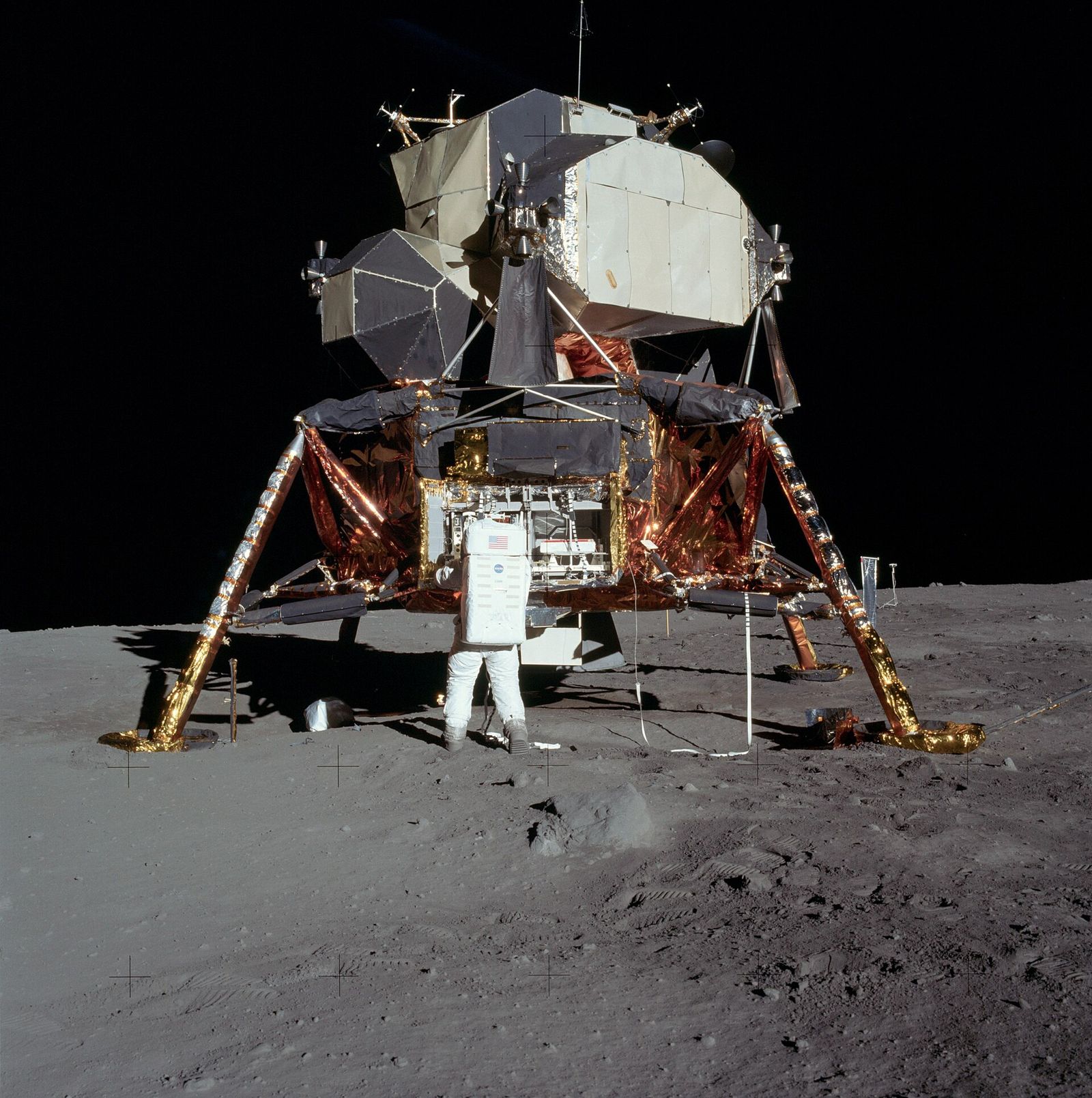
China details four-mission path to a crewed moon landing before 2030
A senior designer laid out the plan in Beijing, and a leaked slide sketches yearly test flights from 2027. NASA is targeting early 2028 for its own landing.
 By Hannah Bell
Published · 5 min read
Key Takeaways
- Two Long March 10 rockets would launch a crew capsule and a lander separately, meeting in lunar orbit before two astronauts descend.
- A presentation slide shared online shows uncrewed test flights in 2027, 2028 and 2029 ahead of the crewed landing.
- NASA is targeting early 2028 for Artemis IV, but its two commercial landers still face key tests.
China has outlined how it plans to put astronauts on the moon before 2030. Two Long March 10 rockets would launch a crew capsule and a lunar lander separately, the two spacecraft would link up in orbit around the moon, and two crew members would then ride the lander to the surface.
Wang Xiang presented the plan in a keynote at the 7th Manned Space Symposium, held Oct. 31 to Nov. 1 at Beihang University in Beijing. Wang is deputy chief designer of China's crewed space program and chief designer of its lunar exploration program. More than 800 experts and scholars in crewed spaceflight attended the gathering.
The "before 2030" goal matches earlier statements from the China Manned Space Agency. It also keeps pressure on NASA, which is aiming to land its own astronauts in 2028 through the Artemis program.
A year-by-year test sequence
The most detailed public timeline so far comes from a presentation slide that an X user shared. CNSpaceflight, an X account that tracks Chinese space activity, publicized the slide on Nov. 1. It lays out four missions:
- 2027: The first launch of the Long March 10A sends an uncrewed Mengzhou spacecraft to low Earth orbit on a cargo run to China's space station. The flight would test the new rocket and the capsule's orbital operations.
- 2028: The heavier Long March 10 makes its debut, carrying an uncrewed Lanyue lander to lunar orbit. Lanyue would land on the moon and then lift off back to orbit.
- 2029: Two Long March 10 launches send Mengzhou and Lanyue to the moon. The spacecraft rehearse rendezvous and docking in lunar orbit, then separate so Lanyue can descend without a crew.
- Before 2030: Two more Long March 10 launches carry a crewed Mengzhou and an uncrewed Lanyue. After docking, astronauts move into the lander for the landing.
Mengzhou means "Dream Vessel," and Lanyue means "Embracing the Moon." According to CNSpaceflight, three astronauts would fly on Mengzhou and two would land. The pair would stay on the surface for three days and go on a moonwalk each day.
Wang described the same step-by-step logic in an interview with China's state broadcaster CCTV. Near-Earth versions of the Long March 10 and Mengzhou would first fly missions to the Tiangong space station in low Earth orbit. Those flights would test the rocket's basic technology and the capsule's reentry and return. Lunar versions of both vehicles would then carry out the landing. "This is the validation process for the rocket: near-Earth first, then the Moon," Wang said.
The two rocket versions differ in size. The Long March 10A used close to Earth is a single core with two stages and no boosters. The lunar version has three stages plus boosters and can lift 27 metric tons, or about 30 U.S. tons.
Lanyue will also fly to the moon without a crew before anyone rides it down. Wang said that flight would collect environmental data on the lunar surface. It would also test as much of the crewed mission as possible, including landing, staying on the surface, lifting off and docking again with Mengzhou. "This is to ensure that the crewed flight is safe and reliable," he said.
Wang added that the program works under a single development framework, with shared system plans, technical standards and quality requirements.
The architecture builds on a preliminary plan from July 2023. At the 9th China (International) Commercial Aerospace Forum that month, Zhang Hailian, a deputy chief engineer of the China Manned Space Engineering office, said two Long March 10 rockets would launch the mission's spacecraft to the moon separately. The office showed the lander design publicly in September 2023 and named it Lanyue in early 2024.
Several hardware tests have already been completed:
- A tethered test of the lander in 2025 simulated descent, guidance, control and engine shutdown.
- In June 2025, Mengzhou passed a set of escape tests, including a zero-height abort test and a maximum dynamic pressure test.
- Earlier this year, the Long March 10 completed a low-altitude demonstration and validation test.
CNSpaceflight argued in a Nov. 2 post that the "before 2030" phrasing was chosen deliberately. It pointed out that 2029 marks the 80th anniversary of China's current government, which gives officials a reason to aim for that year. At the same time, the account said, the schedule for the new rockets, spacecraft and dual-launch operations is aggressive. Under its reading, the phrase "functions as deliberate wording flexibility." A 2029 landing could be presented as an early success, while a slip into 2030 would not force a formal change to the goal.
NASA's competing timeline
NASA flew astronauts around the moon on Artemis II this past April. Before that crewed flight, the uncrewed Artemis I mission sent a capsule around the moon to check its key systems, a similar build-up to the one China is following.
Artemis III is next. NASA officials have said it is on track for summer 2027. The crewed mission will stay in low Earth orbit and test rendezvous and docking between the Orion capsule and one or both of the program's commercial landers, SpaceX's Starship and Blue Origin's Blue Moon.
Both landers still have hurdles ahead. Starship reached Earth orbit for the first time on Sept. 28 and has not yet shown it can refuel in space, which any Starship mission beyond Earth orbit will require. Blue Moon has never flown. Its first flight, an uncrewed test landing on the moon, is scheduled for next spring.
If Artemis III succeeds, NASA plans to launch Artemis IV in early 2028. That mission would land astronauts near the lunar south pole on Starship or Blue Moon; NASA has not said which. If the schedule holds, it would be the first crewed moon landing since Apollo 17 in 1972, and NASA would arrive ahead of China.
Both countries also want permanent bases on the moon within roughly the next decade. China plans to begin building its International Lunar Research Station in 2031 using super heavy-lift Long March 9 rockets. Details remain sparse: the official description says the station could sit on the surface or in orbit.
NASA and U.S. military officials have stressed what is at stake in getting there first. The leader could claim the best sites, gain better access to resources such as water ice and set norms of behavior on the moon.
Sources
Hannah Bell
Hannah Bell writes about physics, experimental discoveries, and the ideas used to describe the physical world. Her coverage explores how researchers test theories, interpret measurements, and investigate unresolved questions. She makes unfamiliar concepts approachable while distinguishing what an experiment demonstrates from the possibilities it may open for future research.
View all stories