Starship Flight 15 could be visible across much of the US before its tower catch try
Ship 42, painted with a "Don't panic" nod to Douglas Adams, should outshine the 26 Starlink satellites it carries in twilight skies, astronomers say.
 By Meera Joshi
· 6 min read
Key Takeaways
- Launch window opens at 5:45 p.m. EST Friday, Nov. 13, from Starbase in South Texas and lasts 75 minutes.
- Ship should be visible in the 90 minutes after sunset Friday and before sunrise Saturday, at latitudes covering most of the contiguous US.
- SpaceX plans to try catching the upper stage with the tower about 22.5 hours after liftoff, but only if the vehicle checks out.
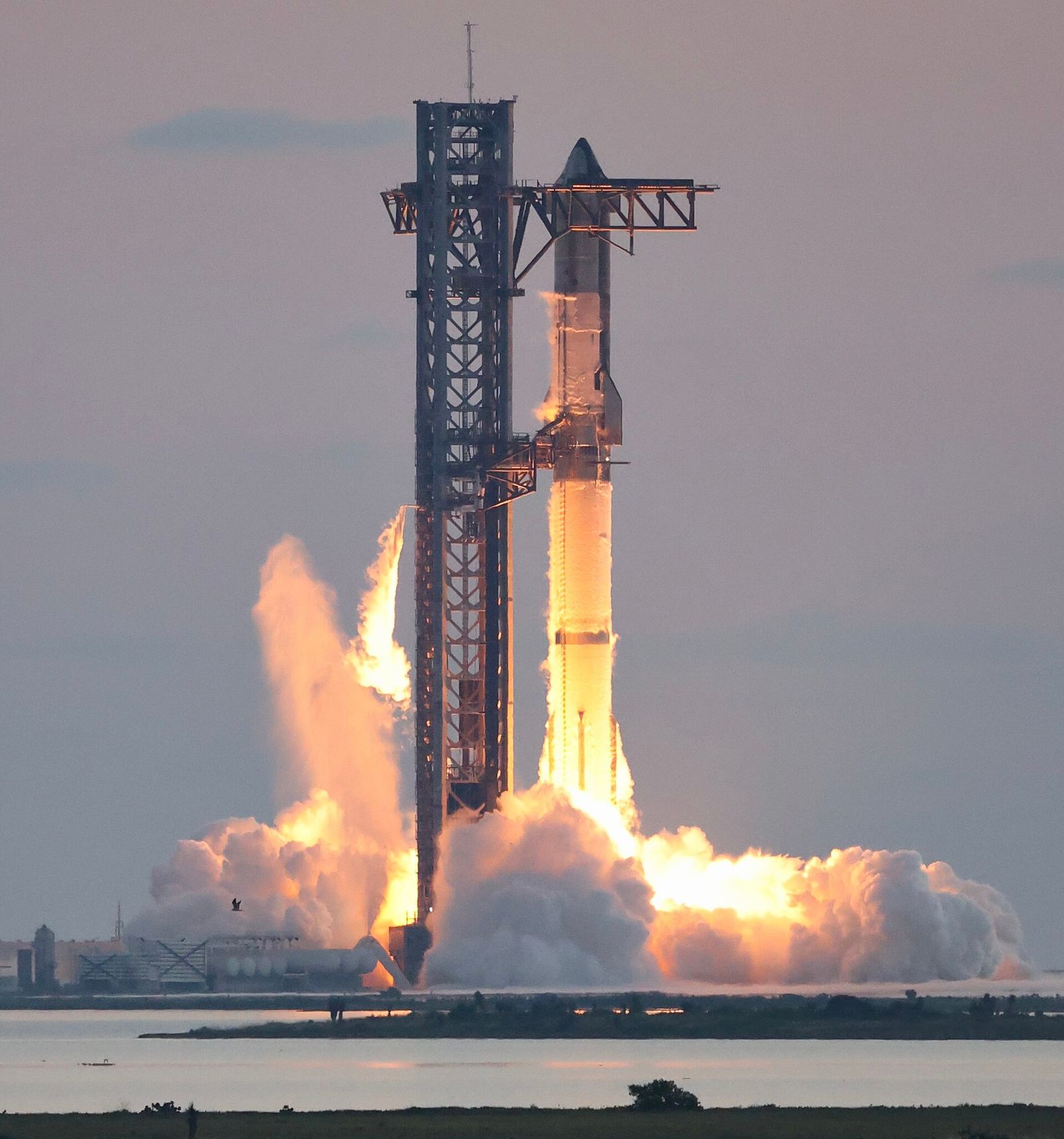
SpaceX's Starship is set to fly its 15th test mission Friday, Nov. 13. If the upper stage reaches orbit as planned, it may be bright enough for skywatchers across most of the contiguous United States to see it on its way to a first-ever attempt to catch it with the launch tower's mechanical arms.
The 75-minute launch window opens at 5:45 p.m. EST (4:45 p.m. local time) at SpaceX's Starbase site in South Texas, roughly an hour before sunset there. The flight plan calls for the Super Heavy booster to return to the tower for a catch about 6.5 minutes after liftoff. The upper stage, called Ship, will stay in orbit for nearly a day before attempting its own catch on Saturday afternoon, Nov. 14, about 22.5 hours after launch.
On Thursday, SpaceX rolled this flight's upper stage, Ship 42, to the pad and posted photos of the move on X. Two words written on the vehicle are easy to spot: "Don't panic."
A Douglas Adams joke with a serious mission
The phrase comes from Douglas Adams' "The Hitchhiker's Guide to the Galaxy," where it appears on the cover of the title's electronic guidebook. The serial number fits the theme too. In the novel, a supercomputer spends 7.5 million years on the ultimate question of life, the universe and everything, and its answer is 42.
SpaceX founder and CEO Elon Musk has used the reference before. The first Falcon Heavy launch in February 2018 sent his red Tesla Roadster into orbit around the sun, with a spacesuited mannequin called Starman in the driver's seat and "Don't panic!" on the car's display.
The joke lands differently this time. The Roadster was a dummy payload on a rocket whose main job was to show it could fly. Ship 42 is carrying 26 next-generation Starlink V3 satellites, only the second batch of that design sent to orbit, and it is being asked to do something no Starship upper stage has tried. SpaceX plans to release the satellites over a 42-minute period that starts about 35 minutes after liftoff.
The catch attempt is the core of the test. SpaceX has caught Super Heavy on three earlier flights but has always brought Ship down in the ocean. The company has said that returning both stages directly to the launch mount would cut the time needed to inspect, refurbish and refly them. In its Flight 15 mission description, SpaceX said a success would be "the first full recovery of an orbital launch system."
Musk has tied that reuse to an ambitious goal: 10,000 Starship missions a year by 2030. That pace only makes sense if vehicles can be turned around in days instead of months, so a tower catch of the upper stage matters far more to the plan than another booster catch.
It is also the harder of the two. Ship flies farther and faster than the booster, so it comes back through the atmosphere with much more energy to shed. The long gap before the attempt makes the test tougher in a useful way. Ship has to spend 14 orbits in space, deploy its satellites and still come back in good enough shape for a precise landing at the tower. Doing the catch after a full day in orbit would tell SpaceX much more than a short hop would.
SpaceX has set a clear safety rule. If anything looks wrong with Ship during the flight, the company will skip the catch and send the vehicle to a Pacific Ocean splashdown near Hawaii or off Chile. Keeping a 171-foot steel spacecraft away from the launch infrastructure unless everything is working is the sensible call, and readers should treat a diversion as a likely result rather than a disaster.
Musk sounded confident last month. "I'd say it's more likely than not that this succeeds next flight," he said during SpaceX's third-quarter earnings call. That is a hopeful forecast, not a promise. Starship only reached orbit for the first time on Flight 14, on Sept. 28.
How to spot Ship from the ground
Because the launch happens in daylight and heads southeast, the best views of the climb itself should be in Texas and the Gulf Coast states, said Robert Massey, deputy executive director of the Royal Astronomical Society, in comments to Space.com. He said observers farther east, where the sky will be darker, might see the spreading exhaust plume that skywatchers call a "jellyfish."
The bigger opportunity comes after that. Ship's orbit takes it as far as 30.5 degrees north and south of the equator. Massey said it should be easiest to see between those latitudes and visible lower in the sky up to 40 degrees north and south. "That's pretty much the whole of the contiguous U.S.," he said.
Timing depends on sunlight. Ship and the Starlinks will be visible mainly in the 90 minutes after sunset Friday and the 90 minutes before sunrise Saturday, when they are still lit by the sun while the ground below is dark. At first they should appear as a line of evenly spaced points of light, with Ship leading the way in brightness.
"It should be very bright, considerably brighter than the Starlink satellites due to its size," James Osborn of Durham University told Space.com. He added a caveat: "Where and when is a bit more tricky." Osborn noted that the limited public data on the flight makes exact pass times hard to predict.
Joe Rao, Space.com's skywatching columnist, compared Ship to the International Space Station. "When it passes overhead, it will look like a bright, fast-moving star crossing the sky," he said, adding that it could look brighter than the station depending on how it is oriented. Ship will orbit at about 170 miles (275 kilometers), lower than the ISS, so it should appear to move a little faster. On a high pass, Rao said, it should stay in view for at least a few minutes.
The Starlink V3 satellites will be much fainter, somewhere between magnitude 2 and 4 depending on how sunlight hits them. On the astronomers' scale, lower numbers mean brighter objects, and the naked eye can reach about magnitude 6.5 under ideal dark skies, so the satellites should still be visible away from city lights. Rao expects the line of satellites to stretch out and fall farther behind Ship as the mission goes on.
Tracking sites including Heavens-Above, Star Dash, Orbital Radar and Find Starlink should help pin down passes after launch. Given Osborn's warning about thin data, it makes sense to check them close to viewing time rather than relying on early estimates.
For most viewers, the main event will come after dark: a bright moving dot that may be the first Starship upper stage SpaceX tries to catch with its tower the next afternoon. Whether that catch happens depends on how Ship 42 performs during its long day in orbit.
Sources
- Space.com — Space: 'Don't panic': SpaceX pens familiar message on Starship ahead of historic double-catch test flight
- Space.com — Space: Watch SpaceX attempt a historic Starship launch and double-catch landing today (Nov. 13)
- Space.com — Space: SpaceX's Starship megarocket will launch to orbit on Nov. 13. Will you be able to spot it in the night sky?
Meera Joshi
Meera Joshi writes about wildlife, animal behavior, and the relationships that shape ecosystems. Her coverage follows studies of species and habitats, with attention to how researchers gather evidence in changing environments. She connects new findings with broader ecological questions while explaining the limits of individual observations and the significance of longer trends.
View all stories