Starship Flight 15 booster reaches the pad as SpaceX lays out a 22-hour double-catch plan
Friday's launch window opens at 5:45 p.m. EST. If the mission runs to the end, the Ship upper stage would return to the Texas tower Saturday afternoon.
 By Meera Joshi
· 5 min read
Key Takeaways
- Booster 22 went through catch testing on the tower arms Nov. 10, including a squeeze test at catch height
- If Starship launches on time, the Ship catch is timed for 4:17 p.m. EST Saturday, Nov. 14
- The flight will deploy 26 Starlink V3 satellites and circle Earth about 14 times at roughly 275 kilometers
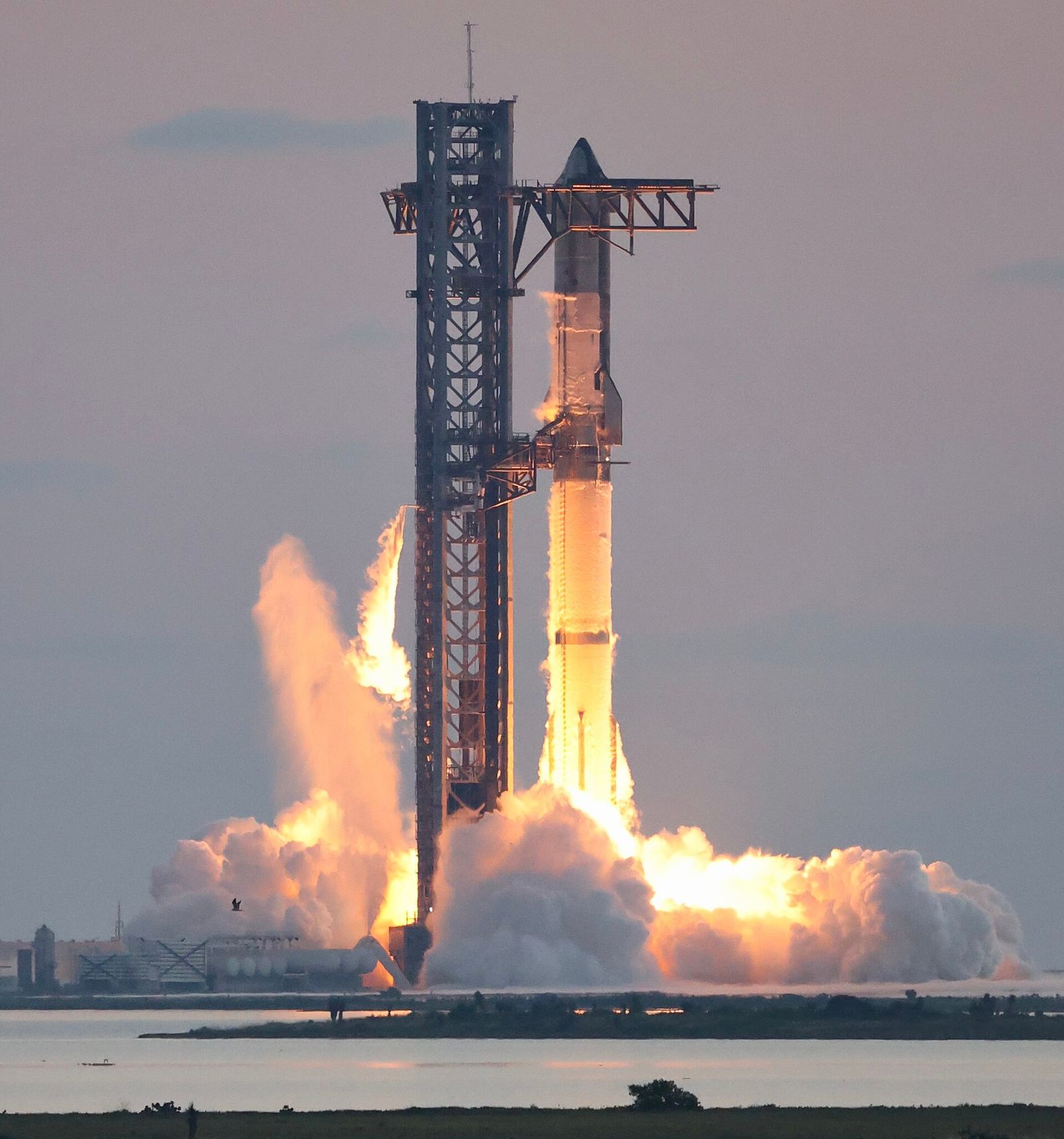
SpaceX moved Super Heavy Booster 22 onto the launch mount at its Starbase facility in South Texas on Nov. 10. Once the booster arrived, the company put it through final catch testing. That work included what SpaceX called a suspended squeeze test at catch height, with the tower's chopstick arms gripping the 33-engine booster high above the pad.
The testing points to the goal of Starship Flight 15, scheduled for Friday, Nov. 13. SpaceX plans to catch both halves of the rocket at the launch tower: the Super Heavy booster minutes after liftoff and the Ship upper stage nearly a day later, after it has been to orbit. SpaceX describes Booster 22 as the first Super Heavy V3 booster planned to return to the launch site for a catch. The engines on both Flight 15 vehicles have already been test-fired.
No one has fully recovered an orbital rocket. Booster landings stopped being novel years ago, and SpaceX's own Falcon 9 first stages have done them for about a decade. Upper stages are a different problem. They reach orbital speed, and to come home they have to survive reentry. That stage is usually the one that gets thrown away. In its mission overview, SpaceX called a full recovery "a breakthrough moment in making Starship a reliable, rapidly reusable rocket."
Launch window and landing times
Liftoff is targeted for no earlier than 5:45 p.m. EST (2245 GMT), or 4:45 p.m. local time at Starbase. SpaceX has a 75-minute window, so the rocket could fly as late as 7 p.m. EST. The company has not formally announced backup days. On past Starship missions that slipped, the new attempt generally kept the same time of day.
The booster portion moves quickly. Under SpaceX's published timeline, Super Heavy's main engines cut off about 2 minutes and 19 seconds after liftoff. The Ship separates two seconds later through hot staging, and the booster then flips into a boostback burn to head back toward Texas. The booster's landing burn begins at T+6:10 and ends at T+6:35, followed by the chopstick catch. That puts the first half of the double recovery roughly six and a half minutes into the flight.
The Ship has a much longer day ahead. Its engines shut down at about T+8:09, and an orbital insertion burn begins at T+26:10. SpaceX says the flight will orbit at roughly 275 kilometers and complete about 14 trips around Earth, deploying 26 Starlink V3 satellites along the way. The planned duration is just over 22.5 hours. An on-time launch would bring the Ship back to Starbase for its catch at 4:17 p.m. EST on Saturday, Nov. 14. A launch at the very end of the window would push that to 5:32 p.m. EST.
That gap is the most important thing to understand about Flight 15. Catching Super Heavy is something SpaceX has done three times before, so a fourth catch would confirm a known capability with a new-generation booster. Catching the Ship would be a first. The Ship flies higher, faster and farther than the booster, and it has to come back through the atmosphere from orbit and line up precisely with a tower built to grab it. Most of the uncertainty on this flight sits in that second half.
Flight 14 is a reason for caution
The most recent mission shows how much can change between liftoff and landing. Flight 14, launched Sept. 28, was the first time Starship reached orbit. It was planned to last nearly 10 hours and circle Earth six times. SpaceX instead ended it after about three hours and two orbits as a safety precaution.
SpaceX has built similar exits into Flight 15. According to its mission description, the profile lets the Ship move onto a passively safe suborbital path or deorbit over the ocean at several preset points after reaching orbital altitude. That is prudent design. It also means a Saturday catch is the best case, not the baseline. Given that the only orbital Starship flight so far was cut to roughly a third of its planned length, a shortened mission this time would be unsurprising. A partial result could still produce useful data even without a historic catch.
The flight also matters for SpaceX's larger plans. The company wants to catch both stages on every operational Starship mission. It says that approach is key to raising its launch rate for the Starlink V3 broadband network and an AI data-center network it calls Starmind. Elon Musk has said SpaceX is aiming for 10,000 Starship flights a year by 2030. Starship is also SpaceX's vehicle for landing NASA's Artemis astronauts on the moon, which the company targets for 2028, and for eventual crewed trips to Mars.
Those ambitions depend on more than one clean catch. A recovered Ship proves the vehicle can come home. Rapid reuse means inspecting it, refueling it and flying it again on a short turnaround, which SpaceX has never done with a Starship upper stage. Flight 15 can settle the first question. The second will take more flights to answer, and the 10,000-flight figure should be read as a goal rather than a forecast.
How to watch
SpaceX will stream the launch on its Flight 15 mission page and its X account, starting about 30 minutes before liftoff, at 5:15 p.m. EST. NASASpaceflight runs round-the-clock camera feeds of the Starbase pads on YouTube. Its launch-day broadcast begins about six hours before the window opens.
For people near the Texas coast, SpaceX has no official viewing area, but several public spots offer a view:
- Isla Blanca Park, South Padre Island: the Cameron County Amphitheater sits about 5 miles from the pad across the bay and has restrooms nearby. Bridge traffic from Port Isabel can be heavy, so early arrival helps.
- Highway 48: roadside pull-offs between Port Isabel and Brownsville are 6 to 8 miles from the site. They are free but have no facilities.
- Playa Bagdad, Mexico: a public beach across the border that faces the launch tower.
- Rocket Ranch: a private campground 3.8 miles from the pad. Tickets cost $200, or $40 for children under 17, and cover one day and one night. Bus transport to the viewing area covers a single launch attempt only.
Because the Ship catch is timed for Saturday afternoon, anyone hoping to see both recoveries in person would need to plan around two separate days at Starbase. That assumes the Ship stays aloft for the full mission, which Flight 14 showed is not guaranteed.
Sources
- Space.com — Space: What time will SpaceX launch Starship Flight 15, its 1st double landing test, on Nov. 13? (Full mission timeline)
- Space.com — Space: SpaceX moves Starship Flight 15 booster to launch pad for 'squeeze test' ahead of epic double-catch attempt (photos)
- Space.com — Space: SpaceX Starship Flight 15 live updates: T-2 days to SpaceX's 1st-ever double Starship landing attempt
- Space.com — Space: SpaceX Starship Flight 15 live updates: Super Heavy rocket moved to launch pad for 1st Starship double landing test
Meera Joshi
Meera Joshi writes about wildlife, animal behavior, and the relationships that shape ecosystems. Her coverage follows studies of species and habitats, with attention to how researchers gather evidence in changing environments. She connects new findings with broader ecological questions while explaining the limits of individual observations and the significance of longer trends.
View all stories