SpaceX will try to catch both Starship stages on Flight 15, targeting Nov. 13
The plan calls for the booster back at the tower within minutes and the upper stage after more than 22 hours in orbit.
 By Isaac Tan
· 4 min read
Key Takeaways
- Launch window opens at 5:45 p.m. EST Friday, Nov. 13, from Starbase in South Texas
- Ship would circle Earth about 14 times at roughly 171 miles up before attempting a tower catch
- The upper stage will again deploy 26 next-generation Starlink V3 satellites
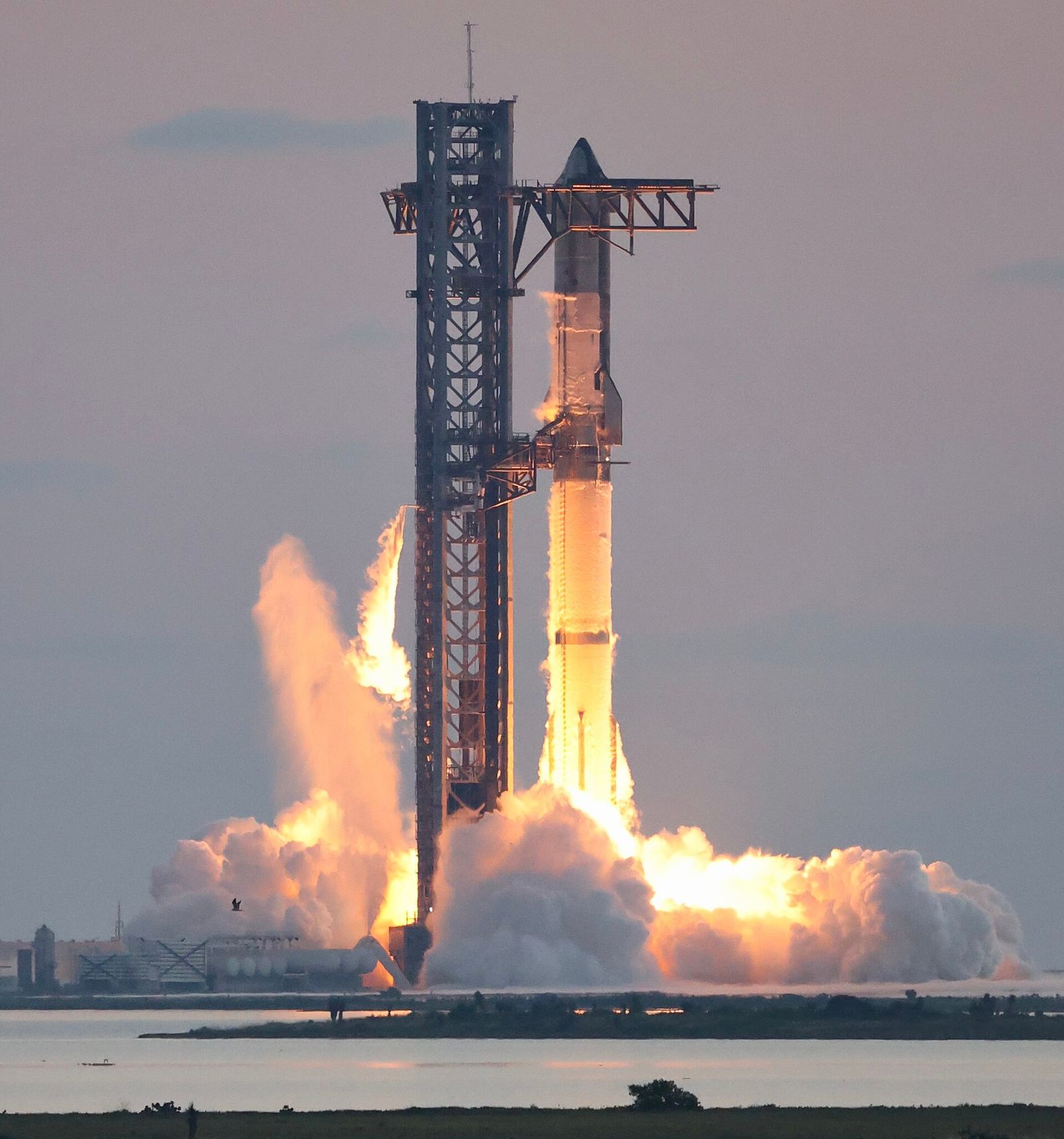
SpaceX plans to try catching both halves of its Starship rocket at the launch tower on a single flight, an attempt the company has scheduled for Friday, Nov. 13. Neither SpaceX nor anyone else has fully recovered an orbital launch system this way.
The company released its Flight 15 mission plan over the weekend. In it, SpaceX said a success would be "the first full recovery of an orbital launch system." It also called the attempt a breakthrough in making Starship a reliable, rapidly reusable rocket. That has been the vehicle's central promise since the program began.
Liftoff is planned from Starbase, the company's South Texas site, in a 75-minute window that opens at 5:45 p.m. EST (4:45 p.m. local time). Elon Musk, SpaceX's founder and CEO, had already signaled that Flight 15 would likely include a double-catch attempt. The mission description adds a date and a flight profile.
Starship has two stages. Super Heavy is the giant first-stage booster. The upper stage, which SpaceX calls Starship or simply Ship, is the spacecraft that reaches space. Both are built to fly again with little refurbishment. Both are meant to come home the same way: by flying back to the launch mount, where the tower's mechanical "chopstick" arms grab them out of the air.
The booster half of that trick is now familiar. Super Heavy has been caught on three Starship flights so far. The first came in October 2024, a moment that turned the chopsticks from a rendering into a working system. On Flight 15, the booster is expected back at the tower about 6.5 minutes after liftoff.
Ship is the hard part, and it has never attempted a catch. It travels much higher and faster than the booster, so it comes back with far more energy to shed through reentry heating and final maneuvering. A booster catch tests precision flying near the pad. A Ship catch tests the whole vehicle: the heat shield, the engines relighting after a long stay in space, and the guidance needed to aim at one tower from orbit.
Ship will also stay up a long time. SpaceX says it will orbit at about 275 kilometers (171 miles) and make roughly 14 trips around the planet during a flight lasting more than 22 hours. If launch happens on time, any catch attempt would come Saturday. The roughly day-long mission likely reflects orbital mechanics. Earth turns beneath a spacecraft's path, so it takes time for Ship's ground track to swing back over South Texas.
SpaceX has designed the mission with off-ramps. After Ship raises its orbit, the company said, it can drop into a passively safe suborbital path or deorbit over the ocean. Several such disposal zones have been picked in advance. The tower catch is the goal, but not the only acceptable ending. If the vehicle's condition looks wrong, it can come down at sea instead of flying over land toward a launch site.
That caution looks sensible rather than timid. A 22-hour mission gives engineers a long stretch to watch how the vehicle holds up in orbit before committing to a return. Aiming a spacecraft the size of a building at the company's own ground infrastructure is a decision that should hinge on that data. A splashdown would still teach SpaceX plenty. A failed catch attempt at the tower could cost far more than one vehicle.
Flight 15 extends what Starship showed on its previous mission. On Flight 14, on Sept. 28, the upper stage reached orbit for the first time. It released 26 of SpaceX's Starlink V3 satellites and then splashed down in the northern Pacific about three hours after launch. Ship will carry the same number of V3 satellites this time.
Those satellites matter to SpaceX's business as much as to its engineering. Musk has said the next-generation network could eventually grow to about 100,000 spacecraft. Launching satellites at that scale only makes economic sense if the rocket comes back and flies again quickly. Reusing the booster alone is half an answer. Throwing away a Starship upper stage on every mission would leave the most expensive piece of hardware as a disposable item.
The same logic applies beyond Starlink. NASA picked a version of Starship to land astronauts on the moon under its Artemis program. That plan depends on many launches to refuel the lander in orbit, and a fleet that can fly repeatedly and cheaply makes such a launch cadence far more plausible.
SpaceX's own history shows why recovering the upper stage is the harder hurdle. The company spent years landing and reflying Falcon 9 first stages. It never brought the Falcon 9 second stage home, because reentering from orbit and landing intact is a much tougher engineering problem. Starship was designed from the start to solve it.
A clean double catch on the first try would be a remarkable result. A more realistic marker of progress might be a successful booster catch, a healthy day-long orbital flight and a controlled return of Ship, wherever it ends up. Even that would leave SpaceX closer to a rocket that can launch, land and launch again without discarding anything. When Friday's window opens, the booster's return about six and a half minutes later will be the first test. Ship's attempt would follow the next day.
Sources
Isaac Tan
Isaac Tan covers biology, biodiversity, and research into the variety of life on Earth. His work follows discoveries about species, evolution, and the connections between organisms and their environments. He explains the evidence behind new findings and the questions they raise, bringing context to developments from genetic studies to ecosystem research.
View all stories