Euclid's first big data release charts more than a billion objects across the sky
ESA's dark universe telescope has published 13 months of observations, including 15,000 strong lens candidates. It covers just 14% of the mission's planned survey.
 By Isaac Tan
· 6 min read
Key Takeaways
- The release counts more than 900 million galaxies, 60 million quasar candidates and spectra from 160 million sources.
- Euclid flagged more than 15,000 strong gravitational lensing candidates, a sample built for weighing dark matter.
- The data, about 1.7 million gigabytes, covers roughly 14% of the area Euclid plans to survey over six years.
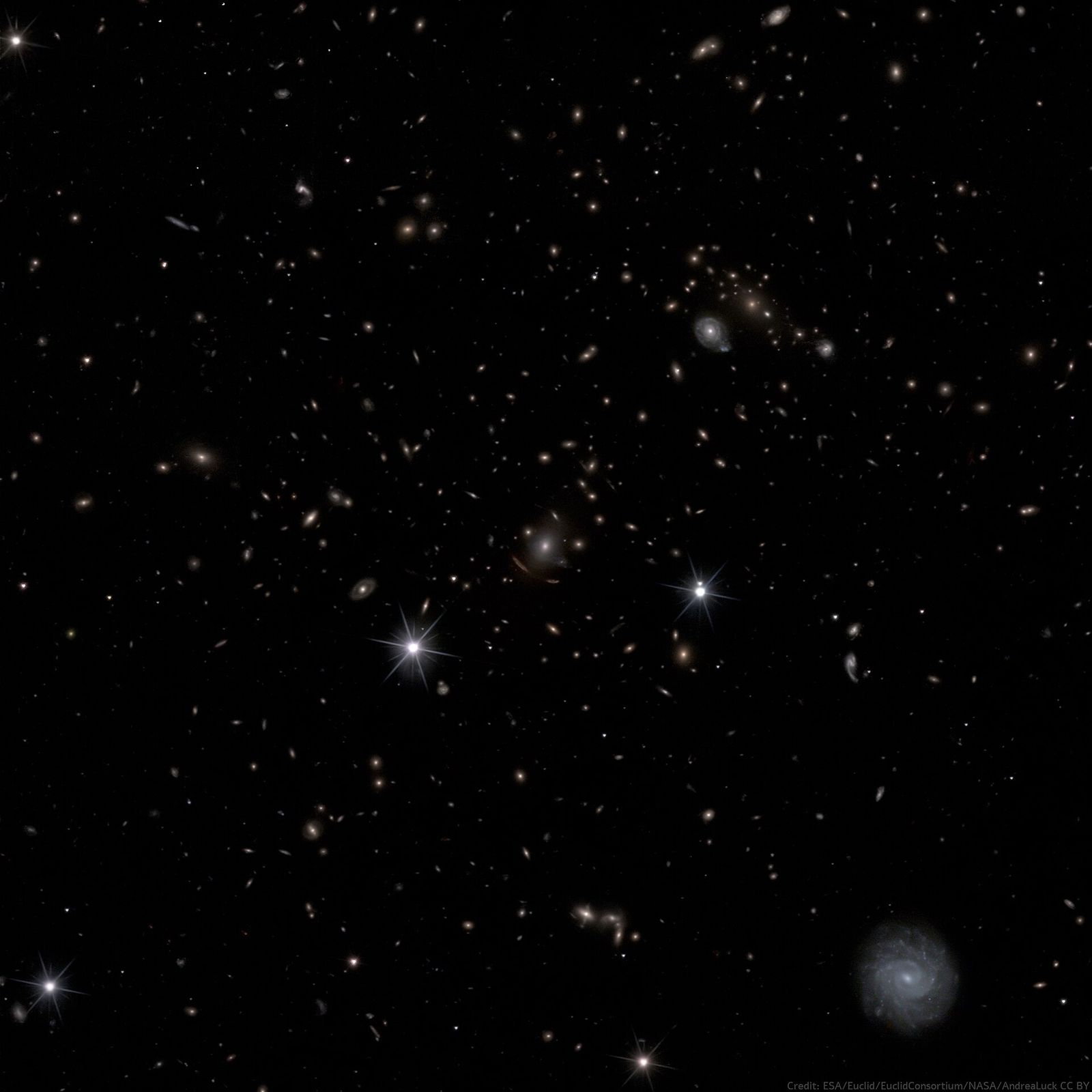
The European Space Agency on Thursday, Nov. 12, published the first major science data release from its Euclid space telescope. The release is a 13-month haul of observations that records light from more than a billion objects across a patch of sky equal to roughly 9,500 full moons.
The release, called DR1-Foundation, is the first large batch of mission data since Euclid launched in mid-2023. It contains more than 900 million galaxies, about 60 million candidate quasars (bright regions powered by feeding supermassive black holes), light spectra for 160 million sources and more than 15,000 candidate strong gravitational lenses. In total it comes to about 1.7 million gigabytes, and it includes raw data, calibrated images and catalogs alongside large sky mosaics.
"These are far more than beautiful pictures; today marks a scientific milestone in our study of the cosmos," Carole Mundell, ESA's director of science, said in a statement. She called it the largest space-based survey of its kind.
That claim is about scale, and the scale is real. What the release does not contain is an answer to the questions Euclid was built to tackle. It is a foundation, as the name says, and the payoff for dark energy and dark matter research depends on how much more sky the telescope maps.
A jump in scale, and still only a start
Euclid had already shown off pretty pictures. ESA published a set of early release observations in 2024 and a quick data release in 2025, and both remain browsable through the agency's ESA Sky portal. But ESA's Euclid project scientist, Valeria Pettorino, said those earlier releases amounted to a few days of observations over roughly 60 square degrees of sky.
"We're now releasing more than a year of data covering a significantly larger area," Pettorino said. The new release spans about 1,900 square degrees, gathered between spring 2024 and spring 2025.
Even so, that area is only about 14% of what Euclid is meant to cover during its planned six-year mission. Every number in this release, from galaxy counts to lens candidates, should be read with that in mind. If the survey stays on schedule, the full catalog will be several times larger, and the statistical power that cosmologists care about grows with it.
The data comes from two surveys that work as a pair. The Wide Survey is the main event: an imaging and spectroscopic campaign in visible and near-infrared light that is designed to sweep across a large volume of the universe and constrain dark energy and dark matter. The Deep Survey takes about 10% of the telescope's observing time, according to ESA, and returns repeatedly to three small regions inside the Wide Survey's footprint. Those repeat looks reach fainter targets such as dwarf galaxies, tidal tails, distant galaxies and quasars, and they help calibrate the wider map.
That division of labor is sensible. A cosmology survey lives or dies on systematic errors, and having deeper, repeatedly observed patches inside the main survey gives scientists a way to check whether the shallower data is quietly missing or misjudging faint galaxies.
Why 15,000 lenses matter more than the pretty pictures
The most consequential line in the release may be the lensing count. A strong gravitational lens forms when a massive galaxy or cluster bends the light of something behind it, magnifying and sometimes duplicating the background object into arcs or rings. Einstein's general relativity, published in 1915, predicted the effect, and the James Webb Space Telescope has used such natural magnifiers to study galaxies in the early universe.
For Euclid's purposes, lenses work as scales. "Strong lensing provides unique insight into the dark universe, allowing us to 'weigh' individual galaxies," said Natalie Lines, a Euclid Consortium member at the University of Portsmouth in the U.K. She said lenses also help researchers study how the universe is expanding.
"Over 10 years ago, we forecast that Euclid would revolutionize the field of strong lens discovery," Lines said. "That day is finally here."
The word to keep in mind is candidates. Lens searches typically turn up look-alikes, and some share of these 15,000 will not survive follow-up. Still, a sample this size, gathered with consistent instruments and drawn from just a seventh of the planned survey area, gives lens researchers far more to work with than piecemeal discoveries ever could. That looks like the part of the release most likely to produce papers quickly.
Galaxy clusters are the other near-term target. "This gives us an unprecedented view of large samples of ancient galaxy clusters that were previously out of reach," said Euclid Consortium member Barbara Sartoris of the J.L. Lagrange Laboratory in Nice, France. She said scientists will study them in the coming months to learn how such giants grew.
What the images show
ESA paired the data with new images that double as demonstrations of the telescope's sharpness.
- The Messier 81 group: Euclid captured the core of this nearby galaxy group, centered on the spiral galaxy M81, its largest member. The smaller galaxy NGC 3077 sits to the left, and faint blue wisps of dust known as galactic cirrus thread through the frame. M81 is bright enough to spot with good binoculars.
- NGC 1291: Nicknamed the Golden Eye, this ring galaxy lies about 33 million light-years away and faces Earth nearly head-on. Euclid imaged it at its highest resolution, showing an inner bar along with inner and outer rings.
- Abell 3128: A cluster of hundreds of galaxies about 800 million light-years away and one of the richest members of the Horologium supercluster. A gravitational lens at its center warps light from a more distant galaxy. In the same frame, the cluster appears to overlap a second one, ACT-CL J0330-5227, though the two are separated by roughly 5 billion light-years.
The Abell 3128 image is the best illustration of why Euclid exists. Massive clusters act as lenses that reveal where dark matter is concentrated. They also test the standard cosmological model, known as Lambda-Cold Dark Matter. The chance alignment of two clusters billions of light-years apart is also a reminder that a flat picture is not a map. Sorting out depth is the job of spectra like the 160 million in this release.
Where Euclid fits in the race to map the universe
Euclid is not alone in trying to build a three-dimensional picture of the cosmic web, the network of filaments, clusters and voids that traces where matter has gathered. The ground-based DESI project has produced the largest 3D map so far. Its early results drew wide attention for hinting that dark energy may change over time, a possibility that would upend the simplest version of the standard model.
Universe Today's analysis is that Euclid's eventual map will exceed DESI's in depth and volume. Working from space, Euclid also avoids the blurring caused by Earth's atmosphere. The two projects are better seen as complementary than competitive. A dark energy result that holds up in both a ground-based spectroscopic survey and a space-based imaging survey, built with different methods and different blind spots, would be far more persuasive than one from either alone.
That is why this release matters even without a headline-grabbing discovery. ESA has now shown that Euclid can deliver data at the volume and quality the mission promised, and it has handed researchers a large public dataset to test their tools on before the bigger releases arrive.
"So much discovery is yet to come," Pettorino said. With roughly 86% of the planned survey area still to be observed, that is less a slogan than an accurate description of where the mission stands.
Sources
- Universe Today — Space: Euclid's First Data Release: A Stepping Stone to its 3D Map of the Sky
- Space.com — Space: Dark matter breakthrough coming? Euclid space telescope unveils its 1st look into the dark universe (video)
- Live Science — Science: Euclid space telescope unveils first major data release, including map of 900 million galaxies
Isaac Tan
Isaac Tan covers biology, biodiversity, and research into the variety of life on Earth. His work follows discoveries about species, evolution, and the connections between organisms and their environments. He explains the evidence behind new findings and the questions they raise, bringing context to developments from genetic studies to ecosystem research.
View all stories