Ferrari drops the hybrid for a lighter, track-focused 296 Challenge Stradale
The first non-hybrid road-going 296 is lighter and laps Fiorano faster than the Speciale, and anyone can order one without a purchase history.

· 6 min read
Key Takeaways
- The V6 runs without the plug-in hybrid system, cutting output to 670 metric hp but trimming weight sharply
- Ferrari says it laps Fiorano half a second quicker than the 296 Speciale
- It costs 291,000 euros in Italy; U.S. deliveries are expected in late 2027
- Production isn't limited, and buyers don't need a prior Ferrari relationship
Ferrari has built a road-going 296 without the electric motor and high-voltage battery. The new 296 Challenge Stradale gives up raw power for lower weight, and the company says the trade makes it the quickest member of the family around a track.
The car revives a badge Ferrari hasn't used since the 360 Challenge Stradale went out of production in 2004. It was revealed at the Circuit de Barcelona-Catalunya alongside the 296 Challenge Evo, the updated racecar for Ferrari's one-make series. The CS is a road car built on the same philosophy as that racer, and the two share aerodynamic parts and suspension hardware.
It also comes to market differently from its recent predecessors. The F430 Scuderia, 458 Speciale and 488 Pista were limited special editions. The 296 Challenge Stradale is a regular-production model, so a first-time buyer can order one at a dealer.
Less power, less weight, faster laps
Every other road-going 296 is a plug-in hybrid. In the CS, the 5-kWh battery pack and the axial-flux electric motor between engine and gearbox are gone, leaving the twin-turbocharged 3.0-liter V6 to work on its own. With race-program hardware from Ferrari's Challenge series, the dry-sump engine makes 670 metric horsepower (about 661 hp) and 546 lb-ft of torque. An eight-speed dual-clutch gearbox drives the rear wheels.
On paper, that looks like a step back. The 296 GTB makes a combined 819 hp and the 296 Speciale 868 hp. But Ferrari quotes a dry weight of 2,932 pounds for the CS, 176 pounds less than the Speciale and more than 300 pounds less than the GTB. That works out to 1.98 kilograms per metric horsepower.
The stopwatch backs up the approach. Ferrari says the CS laps its Fiorano test track in 1 minute, 18.5 seconds. That is 2.5 seconds quicker than the GTB and half a second quicker than the Speciale.
The straight-line figures show the other side of the trade. The CS matches the Speciale's 2.8-second run to 62 mph, but it needs 7.9 seconds to reach 124 mph, 0.9 second longer than the Speciale. Without electric torque, it can't keep pace on a long straight. It earns its lap time under braking and in corners, which suits a car named after a race series.
Removing the hybrid system took more work than unbolting parts. The electric motor had handled jobs the rest of the car still needs. Ferrari had to add a belt-driven starter-generator that also works as an alternator, a mechanical air-conditioning compressor and a new driveline. It also made the flex plate, driveshaft and timing cover lighter.
The V6 was retuned for more low-end response because there's no motor to cover turbo lag. The rear carbon-ceramic brake discs and their cooling ducts were enlarged because regenerative braking is gone. The brakes measure 398 millimeters (15.7 inches) in front and 380 mm (15 inches) in back. Taking mass out of the tail also moved the weight distribution 1.5% toward the front, which Ferrari addressed with changes to the suspension geometry.
Racecar aero, with road manners intact
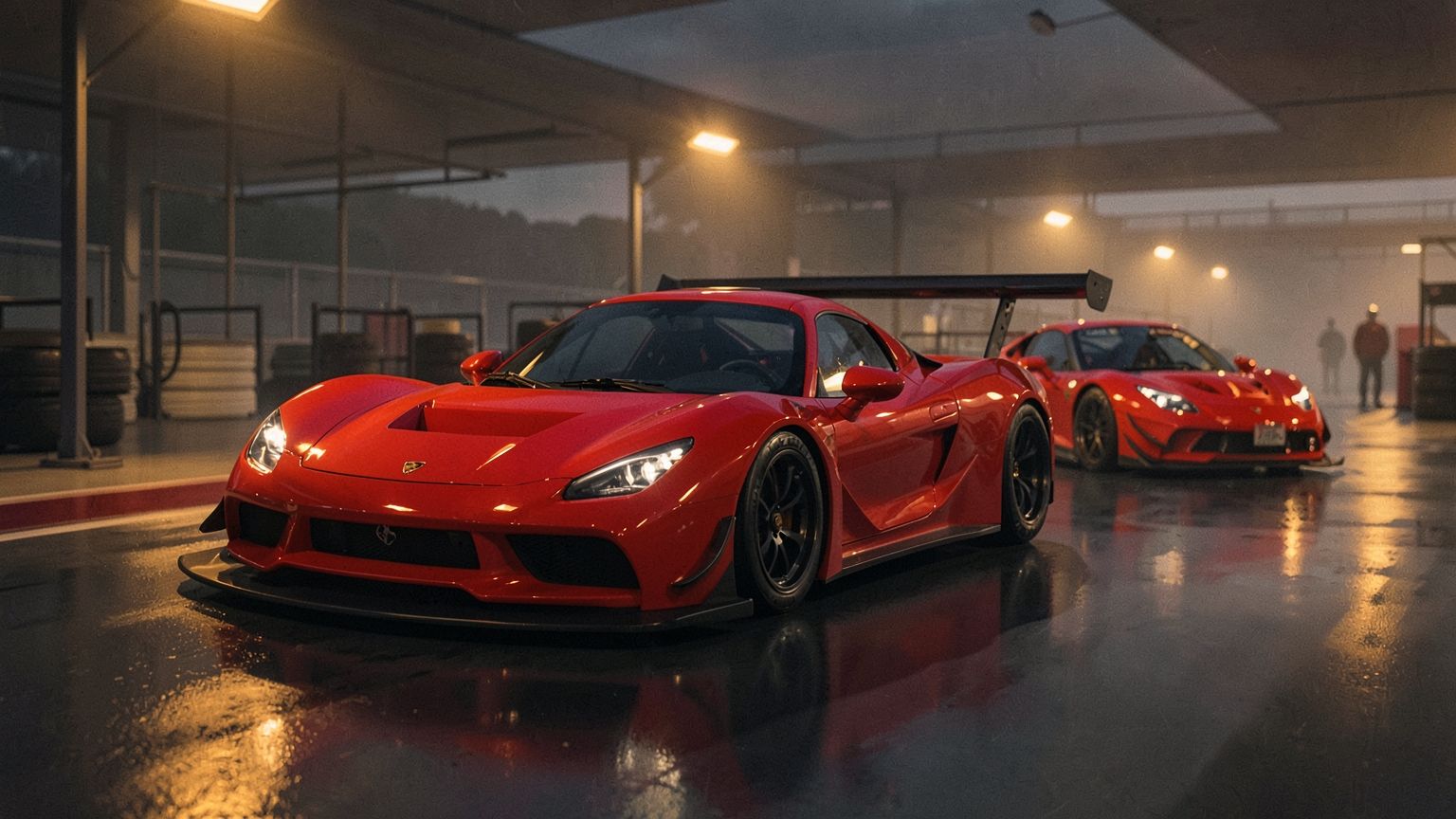
The aerodynamic parts are hard to miss and come largely from the Challenge Evo. Up front are a pronounced adjustable splitter, twin canards on the bumper and a vented hood. At the back are a fixed carbon-fiber wing, side fins and a more elaborate diffuser. A sealed underbody and five pairs of vortex generators, three in front and two in back, add downforce out of sight.
Ferrari rates total downforce at 1,360 pounds at 155 mph. That is 72% more than the 296 GTB and 42% more than the Speciale. It is a big figure for a car with a license plate, and it explains much of the Fiorano advantage.
The suspension, derived from the racecar, pairs recalibrated semi-active dampers with a dual-spring setup. The main springs are nearly twice as stiff, and motorsport-style helper springs improve rebound. Ferrari claims 34% better stability than the GTB and a 68% reduction in roll gradient. Tires are Pirelli P Zero R or Trofeo RS rubber developed for the car, sized 245/35R20 in front and 305/35R20 in back on forged 20-inch wheels. The electronics add a track-tuned predictive slip control, a vehicle-state estimator taken from the F80 hypercar and ABS Evo in all five Manettino drive modes.
Inside, the carbon-fiber door panels and center console come without armrests or storage pockets. Optional carbon seats come from the SF90 XX Stradale. Buyers who want the full race-shop look can order a trim package that removes carpet and under-seat panels and leaves parts of the chassis exposed. Wireless charging, driver-assistance systems, climate control, a stereo, matrix LED headlights and dual cameras remain. A model-specific exhaust is standard, and Ferrari offers a louder, non-homologated system for track use only. That's a nod to the 360 Challenge Stradale, a car known for being very loud.
Price, availability and who it's for
In Italy, the 296 Challenge Stradale costs 291,000 euros, roughly $320,000. Ferrari hasn't announced U.S. pricing, and American deliveries are expected to begin in late 2027.
The way Ferrari sells it may matter more than any lap time. The 296 Speciale belongs to the company's special series, which requires buyers to have an "existing relationship" with Ferrari to get an allocation. The CS is a standard range model, and its production isn't capped. Ferrari says the two cars serve different buyers and that the CS won't take sales from the Speciale. The company also says it wants to attract new customers looking for its most direct driving experience.
That looks like a smart move. Ferrari has long rationed its most focused cars to repeat customers, which keeps them exclusive but locks out serious drivers who don't have a garage full of Ferraris already. Putting a stripped-down, quicker-lapping car in the regular catalog gives those buyers a way in. The open question is how Ferrari will keep the Speciale's appeal intact when an unlimited model beats it on its home track.
Dropping the hybrid also cuts against the industry's push toward electrification. Ferrari isn't abandoning plug-in power, since the GTB and Speciale keep it. But on a car built for the track, the CS shows that the battery and motor were costing lap time through their weight.
As for the racer, the 296 Challenge Evo uses a non-hybrid V6 rated at 700 metric horsepower with a seven-speed dual-clutch gearbox. Revised aerodynamics give it 12% more peak downforce than the 296 Challenge it replaces, and Ferrari says it laps Mugello 0.8 second faster. It enters the 2027 Ferrari Challenge seasons in Europe and North America, and regional series follow in 2028.
Sources
Dominic Price
Dominic Price writes about new cars, pickup trucks, and SUVs, following model announcements and changes across vehicle lineups. His coverage connects pricing, dimensions, powertrains, and equipment with the choices facing buyers. He puts published specifications in context and explains differences between models, making crowded launch calendars and trim descriptions easier to follow.
View all stories