Dutch court bars BYD's Ti7 from the EU over Land Rover Defender design
A preliminary injunction blocks sales and production across the bloc, including at BYD's Hungarian plant. UK deliveries are still scheduled for January 2027.

· 5 min read
Key Takeaways
- BYD faces penalties of €100,000 a day, capped at €10 million, if it breaks the order
- The ban reaches BYD's new factory in Szeged, Hungary, though not its UK business
- BYD says it will appeal, but the injunction stays in force while it does
- A separate JLR case over copyright and imitation has a hearing in Rotterdam this week
BYD can no longer build or sell its Ti7 SUV anywhere in the European Union after a Dutch judge ruled that the three-row plug-in hybrid infringes Jaguar Land Rover's registered design for the Land Rover Defender.
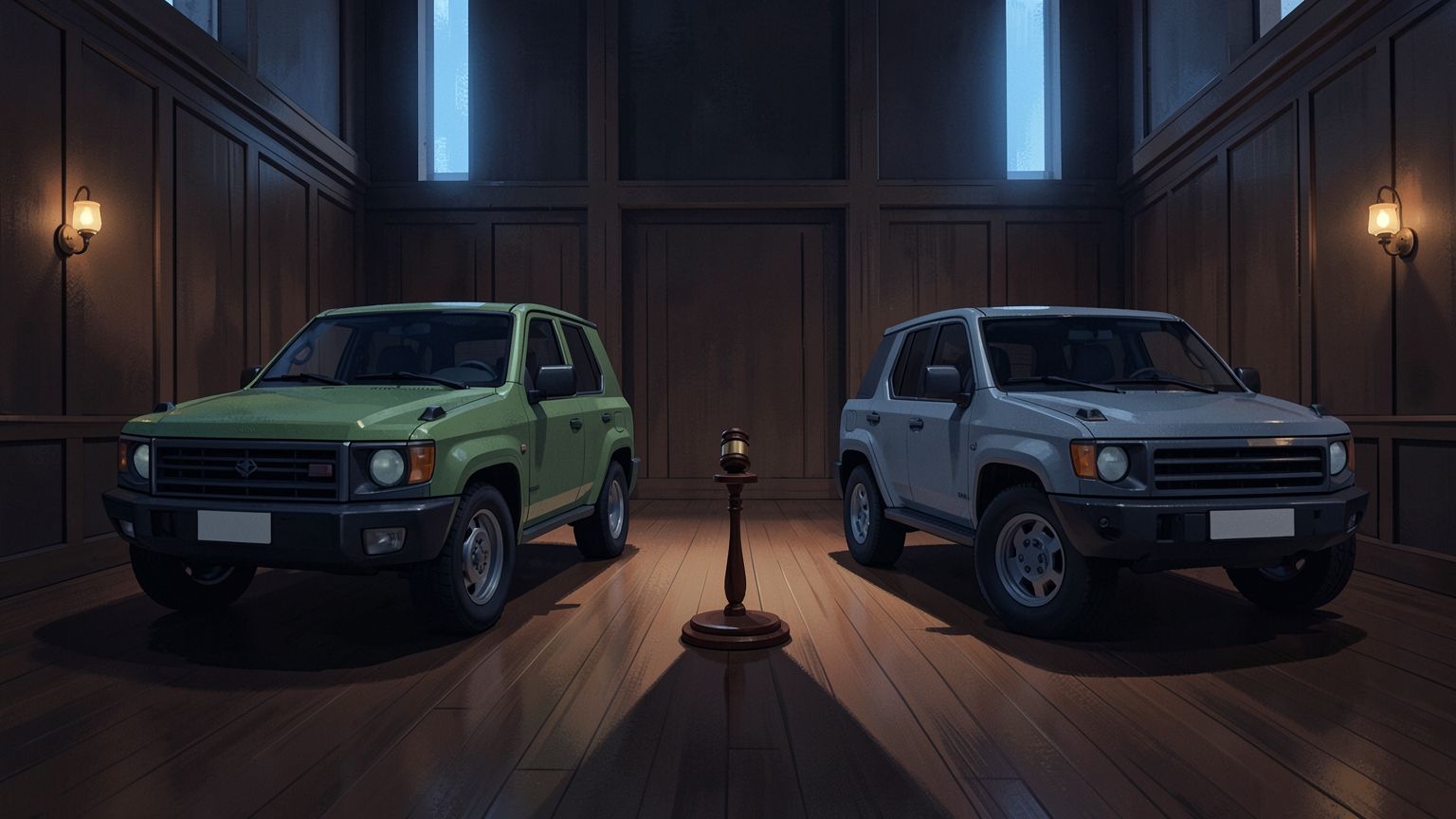
The preliminary relief judge at the District Court of The Hague ruled Friday, Nov. 20, in summary proceedings JLR brought against 11 BYD companies. Under the injunction, BYD's EU entities may not import, produce, offer, sell, store or supply the Ti7. Each day of violation carries a €100,000 penalty, up to a maximum of €10 million. The order takes effect one week after it is formally served on BYD.
The decision reverses BYD's fortunes in a matter of days. Earlier this month, the same court had given the Chinese automaker an early win in the dispute. Investors reacted Monday, when BYD's Hong Kong-listed shares fell as much as 4% during the session and closed 1.9% lower.
One registered design decided the case
JLR presented six registered EU designs, and the judge needed only one: a design registered in April 2018 that covers the current Defender 110, known internally as the L663. The court identified the features that dominate that design as the rounded shoulders, the rounded corners, the signature panel on the C-pillar, the wheel-arch cutouts with rounded corners, the unbroken window line and the overall silhouette. It found all of them on the Ti7.
BYD argued that its headlights, grille, bumpers, hood and side profile set the Ti7 apart. The judge rejected that defense, finding that the differences, whether taken one at a time or together, would not give an informed user a different overall impression.
"The differences noted by BYD are not sufficiently striking to significantly influence the overall impression," the court ruled.
The court also concluded that the Ti7 resembles the Defender more closely than it resembles older boxy SUVs such as the Ford Flex, Jeep Wrangler and Mercedes G-Class. That comparison mattered. It rebutted any suggestion that the Ti7 simply belongs to a generic family of square-shouldered off-roaders.
This is how design law is supposed to work. JLR does not own boxiness, and it has learned that the hard way: it failed to secure trademark protection for the classic Defender's shape in the U.K., a setback in its long fight with the Ineos Grenadier. A registration for one specific combination of shoulders, pillar panel and wheel arches is far more precise, and that precision made it easy to enforce. JLR did not need to prove that BYD copied anything. It only needed to show that the Ti7 leaves the same overall impression as the registered shape.
A ban on a car BYD wasn't selling
The odd part of the ruling is that the Ti7 is not on sale in the EU. BYD told the court it has no concrete plans to launch the SUV there and that it can only be ordered in the U.K. The judge found a threat of infringement anyway. By BYD's own account, it developed the seven-seat layout for the U.K. and Europe. A promotional video described the Ti7 as the first seven-seat SUV "in Europe." BYD also would not commit to keeping the model out of the EU.
BYD's marketing ended up undercutting its legal defense. An automaker that pitches a car to Europe should not be surprised when a European court treats it as headed there. The most consequential detail may be the ban's reach into BYD's Hungarian unit. The judge considered it conceivable that the Ti7 could be built at BYD's new factory in Szeged. That plant is central to BYD's plan to produce cars inside the EU, so a court naming it in a design injunction sends a message about which products it can build there.
The ruling does not touch Britain. The court said it has no jurisdiction over BYD UK and dismissed JLR's U.K. design claims. That leaves the one European market where BYD has opened orders unaffected, with deliveries still planned for January 2027. BYD prices the Ti7 at £47,995 in the U.K., roughly £24,000 below the £71,840 plug-in Defender 110.
BYD said it "strongly disagrees" with the judgment and will appeal. The company said the Ti7 "is the result of BYD's own independent design work and infringes none of JLR's rights." JLR told AFP that it protects its intellectual property and takes legal action when necessary.
Appeals, deadlines and a second lawsuit
BYD has four weeks to file an appeal, and the injunction remains in effect in the meantime. Because this is a preliminary ruling, JLR has six months to bring a full case on the merits. If it does not, BYD can seek to have the injunction lifted. The ban also applies only until the Ti7 is substantially redesigned, which leaves BYD a practical option: change the specific features the court singled out.
JLR is pursuing a second front. It has filed a separate case in Rotterdam alleging copyright infringement and "slavish imitation," with a hearing scheduled for Wednesday, Nov. 25.
The dispute began in August, when bailiffs acting for JLR raided BYD's Dutch offices in Schiedam and Hoofddorp to secure documents. A court later ordered JLR to destroy the seized material, finding that it did not need BYD's internal files to make its design case. The Hague ruling bears that out, because JLR prevailed on its design registration alone.
The resemblance is mostly skin-deep. The Ti7, sold in China as the Fang Cheng Bao Tai 7, uses a plug-in hybrid system built around a 1.5-liter four-cylinder engine with a combined 402 horsepower. JLR offers the Defender with inline-six and V8 engines.
JLR has a track record of going after lookalikes. In 2016 it took Jiangling Motors to court in China over the Landwind X7's resemblance to the Range Rover Evoque, and it won. It has not acted against Chery's Jaecoo 7, an SUV whose resemblance to the Evoque and Velar has earned it the nickname "Temu Range Rover." The Ti7 stands apart from both in one concrete way: it was offered in Britain, the Defender's home market, at a steep discount to the model it resembles.
The near-term business impact on BYD looks limited. Electrek estimates that the Ti7 sells roughly 30,000 units a month, almost all of them in China, and the U.K. launch is going ahead. The more lasting effect is likely to be on Chinese automakers' design studios. Defender-style SUVs have been common in China for years, mostly for the domestic market. This ruling shows what can happen when one of them is pitched to Europe without enough changes.
Sources
Julian Morales
Julian Morales follows automakers, vehicle manufacturing, and the supply chains behind the cars reaching dealerships. His coverage connects factory plans, production figures, supplier developments, and company announcements with broader industry changes. He explains how manufacturing decisions and parts availability can influence vehicle output, delivery schedules, and the direction of the automotive business.
View all stories