Tesla's FSD v15 targets potholes and school zones, but its 25x claim is unverified
The update adds a detailed live view of what the car plans to do, while loosening driver monitoring in faster driving profiles.
 By Serena Wu
· 5 min read
Key Takeaways
- Tesla says v15 handles safety-critical cases 25 times better but has not published the underlying intervention rate.
- New features include pothole avoidance, slowing for speed cameras, a Bike Rack Mode and a live Reality View visualization.
- Tesla is relaxing driver-monitoring strictness in higher-speed profiles while tightening it in Europe at regulators' request.
Tesla has begun rolling out version 15 of its "Full Self-Driving" software. Its release notes read like a list of the system's best-known failures: misread speed-limit signs, potholes and school zones. The headline claim is that the new software is 25 times better at handling safety-critical situations, but Tesla gave only the multiplier, not the figure it is multiplying.
The company announced the rollout on X on the afternoon of Nov. 21, and its Tesla Super Intelligence account then posted the full notes. Tesla did not say which vehicles would get the update first. It has previously told investors that its AI4 computer, also called HW4, can run v15.
FSD remains a supervised system, so the driver is still responsible for watching the road. That matters for how to read everything below.
What changes in the car
Tesla says v15 upgrades every part of its end-to-end driving network, the single AI model that turns camera input into steering, braking and acceleration. The list of practical additions is long:
- Better sign detection and handling of school zones, according to the release notes
- Pothole avoidance
- Slowing down for speed cameras
- A Bike Rack Mode that allows FSD to run with a bike rack or similar hitch accessory attached
- Navigation learning, which for now covers only the start and end of a trip; Tesla says later v15 releases will extend it to the whole route
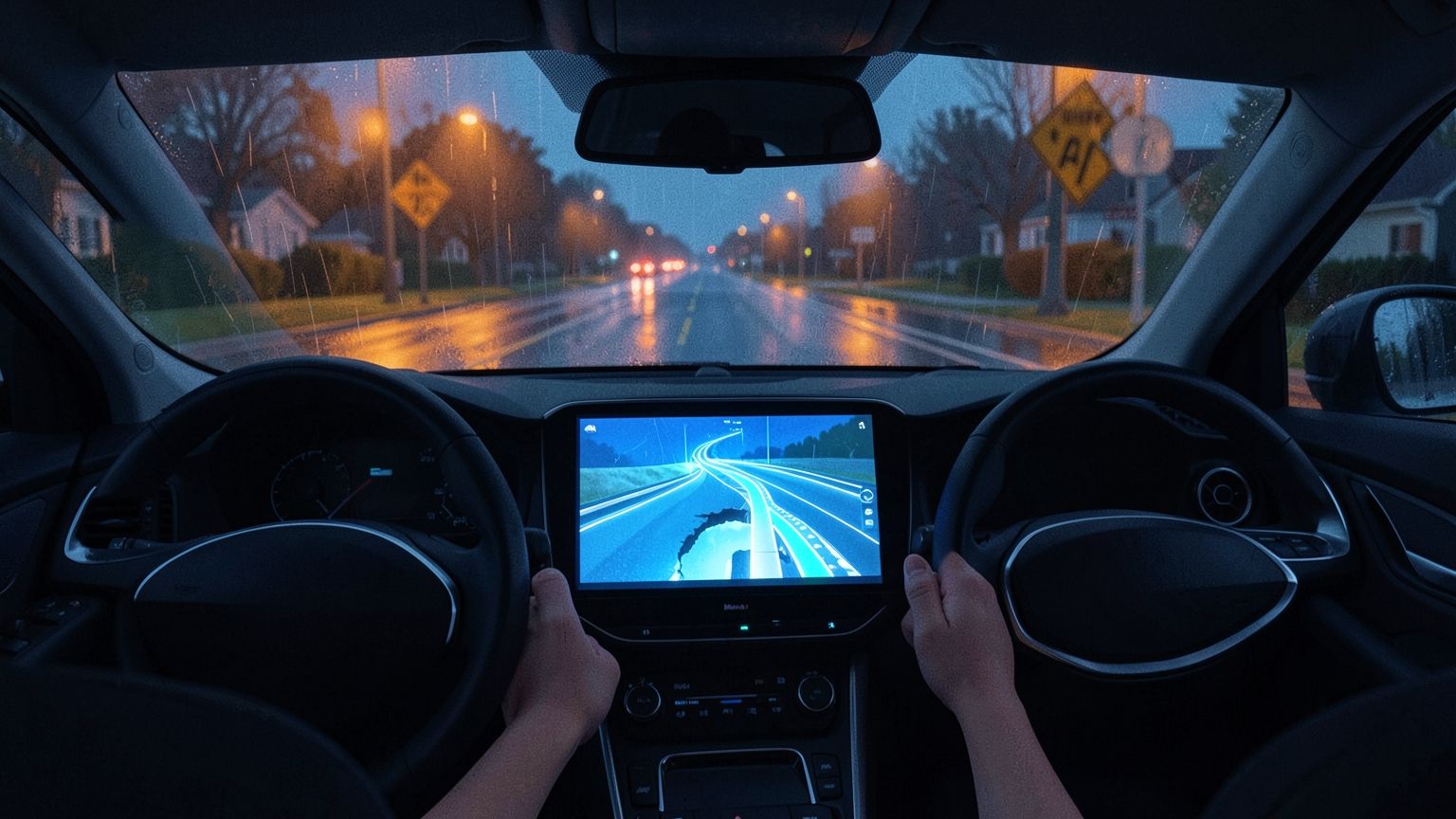
The most visible change is on the center screen. Tesla calls it "Reality View" in its announcement and "Tesla Augmented Reality" in the release notes. It replaces the current patchwork of on-screen signals with a single, detailed rendering of the street around the car, which Tesla says uses less computing power. The company says it lets drivers "see & control what FSD is planning to do."
That could be the most useful part of the update, not just the flashiest. A supervised system depends on a human catching mistakes before they happen. A display that shows the car's intended path in advance gives the driver a better chance to step in, rather than reacting after the car has already committed to a bad move. Whether Reality View works that way on real roads is something only owners will be able to judge.
Pothole avoidance carries some history. Elon Musk said in August that it was "coming soon," a promise he had already made in 2019. Until now, FSD has driven straight through them.
The weaknesses Tesla is targeting
Nearly all of the driving changes go after areas where FSD currently falls short, and several have drawn complaints from owners and regulators alike.
Speed limits are the clearest case. In a September test, the Brussels nonprofit Johanna.be found that FSD went over the limit in 55% of the 30 km/h zones it drove through, averaging 44 km/h. In most of those zones, the car's display showed a 50 km/h limit, which means it had not read the posted sign. Better sign detection is aimed squarely at that failure.
School zones carry regulatory weight. The National Highway Traffic Safety Administration is reviewing a petition alleging that Tesla's robotaxis speed through active school zones. That review sits on top of an investigation the agency opened in October 2025 into FSD traffic-law violations, including running red lights.
The speed-camera feature is harder to praise. Teaching a car to slow down where it might be ticketed implies that elsewhere it may still drive above the limit, which is the problem the Johanna.be test documented. A system that obeys the posted sign everywhere would make the feature unnecessary.
One change cuts against the safety theme. Tesla says it is "decreasing strictness" of driver monitoring in its higher-speed driver profiles. That comes as reports of drivers falling asleep with FSD engaged keep surfacing, and as Tesla tightens monitoring in Europe at regulators' request. Loosening attention checks in the profiles built for faster driving is hard to square with a release pitched around safety-critical improvements.
What the 25x figure does and doesn't prove
The release notes say a new vision encoder improves the critical intervention rate by 25 times. That is the right yardstick, because it tracks how often a human has to take over to prevent a problem, the number that will decide whether FSD can ever drive without supervision. Tesla, however, has never published the baseline.
Electrek ran the math using its own figures. The outlet estimated earlier this year that v14 could go roughly a couple thousand miles between critical interventions. A 25-fold gain on that would put v15 near 50,000 miles, far beyond the roughly 10,000 miles Electrek has said Tesla would need for a limited unsupervised service. That is a projection stacked on an estimate, though, not a measured result.
Tesla's own track record argues for caution. When v14 arrived in October 2025, early crowdsourced data showed about 732 miles between critical disengagements, along with reports of hallucinations, abrupt braking and excessive speeding. The software improved sharply, then the v14.2 updates regressed before Musk promoted v14.3 as the release where "the last big piece of the puzzle finally lands." Months of point releases later, owners are still supervising.
The buildup to v15 has been just as loud. In April, Musk wrote that it "will far exceed human levels of safety, even in completely unsupervised and complex situations." He made similar claims about v12 and v14. In August, Tesla told JPMorgan that v15 was a "step-change" built on seven core technologies, about 40% of which were already running in its robotaxi fleet in Austin, Texas.
None of that settles whether v15 drives better. The visualization can be judged from Tesla's video, and it looks like a real advance in showing drivers what the car is thinking. The driving claims can't be judged that way. "Improved detection" doesn't say how much better, and a multiplier without a starting number can't be checked. Tesla could end the guessing by publishing its intervention data. Until it does, the most reliable evidence will come from owners logging miles on the new software, and from whether the next point release keeps the gains or loses some of them, as earlier versions have.
Sources
Serena Wu
Serena Wu covers vehicle safety, recalls, and the systems designed to help drivers avoid collisions. Her work follows official notices, safety ratings, and updates to driver assistance features. She explains which vehicles are affected, what published findings establish, and where limitations remain, giving readers clear context for automotive safety news.
View all stories