Webb spots a red speck from 450 million years after the Big Bang that may hide a young black hole
If confirmed, CW-LRD-z10 would be the earliest known little red dot. A key spectral signature is still missing, and Webb is scheduled to look again in 2027.

· 5 min read
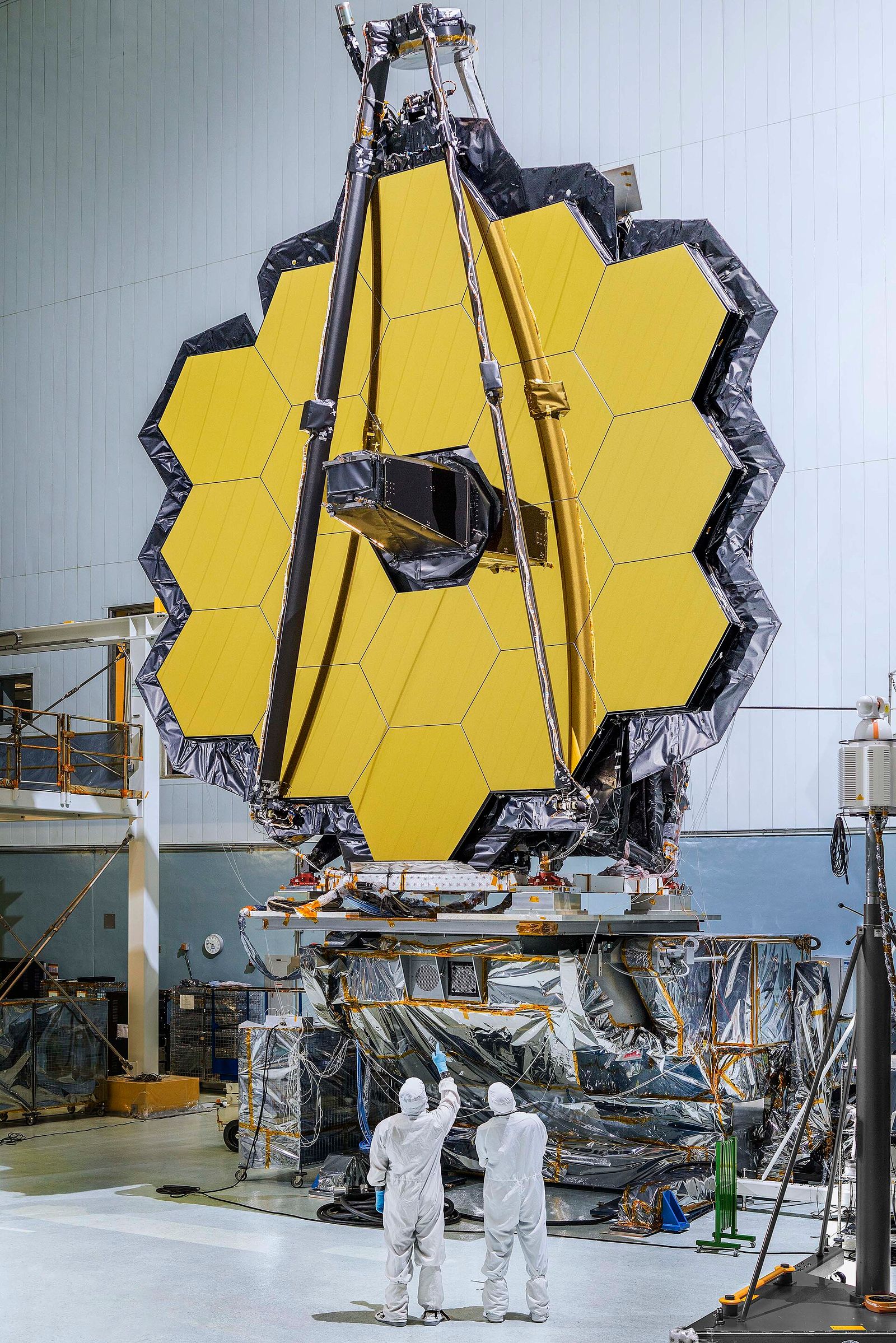
A faint, intensely red point of light caught by the James Webb Space Telescope appears to date from when the universe was just 450 million years old. If astronomers confirm what it is, it would be the earliest known example of a "little red dot," a puzzling class of objects that many researchers suspect are black holes growing inside thick shrouds of gas.
The object, named CW-LRD-z10, is described in a study published Nov. 24 in The Astrophysical Journal Letters. The team, led by University of Tokyo doctoral student Takumi Tanaka, measured its redshift at 10.36. That places its light at roughly 3% of the universe's current age of about 13.8 billion years.
The key word is "if." The researchers call the object a candidate, not a confirmed little red dot. They have also been unusually direct about the gaps in their evidence, and that candor is the most reassuring part of the paper.
Little red dots are one of the stranger results of Webb's science operations, which began after its launch in December 2021. They are compact, very red sources scattered through the early universe, and nobody agrees on what powers them. The leading idea is a feeding black hole buried in dense gas. Competing explanations include supermassive stars, so-called black hole stars and tightly packed star clusters.
Distance makes the problem harder. Light from far-off objects stretches toward longer, redder wavelengths as the universe expands, an effect called redshift. Webb's near-infrared camera can trace these objects only to a redshift of about 9, which corresponds to light emitted about 13.1 billion years ago. To push further, the team searched in 2025 with the telescope's mid-infrared instrument, known as MIRI. Tanaka told Live Science that CW-LRD-z10 was the only candidate the search found.
A single hit from a dedicated hunt is worth keeping in mind. It may mean such objects were rare that early, or simply that they are very hard to pick out at that distance. Either way, one object is a starting point for study, not a population.
The distance estimate rests on a sharp drop in the object's light, which the team reads as a Lyman-alpha break. That feature forms when hydrogen gas between a source and the observer absorbs light below a specific wavelength. Roberto Maiolino, a professor of experimental astrophysics at the University of Cambridge who was not involved in the research, told Live Science the drop looks fairly convincing and that the redshift determination is "reasonably robust."
Several clues point toward the little red dot interpretation. The object is much redder in the mid-infrared than in the near-infrared. Its spectrum shows the V-shaped dip characteristic of these objects, hints of iron emission, and tentative emission lines with ratios similar to those seen in other little red dots and in active black holes.
Tanaka said none of those signs settles the question by itself, though together they back the team's reading. The iron is the most intriguing of them. Such emission is generally linked to gas swirling close to actively feeding black holes, as in quasars, rather than to ordinary star-forming galaxies. Tanaka said confirmation would support the presence of accreting black holes and suggest that gas enriched with heavy elements already surrounded the possible black hole.
That would be a notable detail on its own. Elements heavier than hydrogen and helium are forged in stars, so finding iron-bearing gas this early would suggest substantial stellar activity had already happened nearby within the universe's first half-billion years.
The biggest weakness in the case is something the spectrum doesn't show. The defining fingerprint of a little red dot is a set of broad hydrogen emission lines, and the new observations don't include them. That isn't evidence against the idea. The wavelengths where those lines would appear fall outside the range the study covered. Still, it means the strongest test hasn't been run.
"At this stage, this should only be considered an LRD candidate," Maiolino said, and Tanaka agreed that the object is more appropriately described as a very promising candidate for now.
The team also weighed two other explanations. One is that the sharp drop is a Balmer break, a feature produced by older stars, which would put the object much closer, at a redshift of about 3, or roughly 11.4 billion light-years away. Tanaka said the data argue against this. The object's color is hard to reconcile with such a galaxy, the emission lines expected at that distance weren't detected, and the break appears too strong to come from a normal population of stars.
The second possibility is harder to rule out. An ordinary star-forming galaxy at the same redshift of 10.36 could, in principle, look this red, but only if it had an unusually strong emission line. That line also lies outside the current spectrum, so the question remains open for now.
That leaves the object in a familiar spot for early-universe astronomy. The case is suggestive and the distance looks solid, but the crucial evidence lies just beyond the wavelengths the instruments have covered so far.
The stakes go beyond one distant speck. Astronomers have long struggled to explain how supermassive black holes grew so large so soon after the Big Bang. Broadly, the debate is whether they started from small seeds left by dead stars or from heavier seeds that formed directly from collapsing gas clouds. Maiolino said that if CW-LRD-z10 does host an accreting black hole, its properties could help scientists sort among those seeding scenarios.
Tanaka was more restrained. Because the nature of little red dots and their place in black hole evolution remain unsettled, he said, the team can't yet draw firm conclusions about what the object means for how the first supermassive black holes formed. That restraint seems right. An early black hole, a giant star or an odd galaxy would each say something very different about the young universe, and the current data can't yet tell them apart.
The decisive test is already on the calendar. Webb's MIRI is scheduled to take a spectrum of the object in 2027, designed to detect hydrogen and oxygen emission lines along with the underlying continuum. That should let the team tell whether the red glow is real or an artifact of strong emission lines. The same observation could also catch the broad hydrogen lines that would confirm a little red dot.
"We're really looking forward to seeing the data," Tanaka said. Until then, CW-LRD-z10 remains a well-argued candidate rather than a record.
Sources
Theo Anderson
Theo Anderson covers astronomy, space discoveries, and the observations expanding our picture of the universe. His work follows telescope findings, planetary research, and the questions behind new results. He explains the tools and concepts involved, placing striking images and announcements in context so readers can understand what scientists have learned.
View all stories