Euclid finds the most distant quasar yet, and its giant black hole is eating slowly
Seen 630 million years after the Big Bang, the quasar Dún Aonghasa breaks the redshift 8 barrier. Its calm appetite makes early black hole growth harder to explain.
 By Isaac Tan
· 6 min read
Key Takeaways
- The quasar J1504+6252, nicknamed Dún Aonghasa, sits at redshift 8.13, the first quasar confirmed beyond redshift 8.
- Its black hole holds about 360 million solar masses but is feeding below the Eddington rate.
- Euclid spotted it, and Keck, the Large Binocular Telescope, Hubble and Webb confirmed it.
- Researchers have projected that Euclid could find 8 to 23 quasars beyond redshift 8.
The European Space Agency's Euclid telescope has found the most distant quasar ever confirmed. It is a brilliant galactic core seen as it looked about 630 million years after the Big Bang. Its light has traveled for roughly 13.1 billion years, and it pushes the quasar record back by about 40 million years.
The object is cataloged as J1504+6252 and nicknamed Dún Aonghasa. It sits at a redshift of 8.13, which makes it the first quasar confirmed beyond a redshift of 8. A supermassive black hole of about 360 million solar masses powers it. The results appeared Tuesday, Nov. 24, in the journal Astronomy & Astrophysics. Julien Wolf led the paper and did the work as a postdoctoral researcher at the Max Planck Institute for Astronomy.
The record will draw the attention, but the stranger detail is how the black hole is behaving. It is enormous for its age, yet it is currently feeding at a fairly modest rate. That combination makes it harder, not easier, to explain how black holes this large appeared so early.
How a dark energy telescope caught a quasar
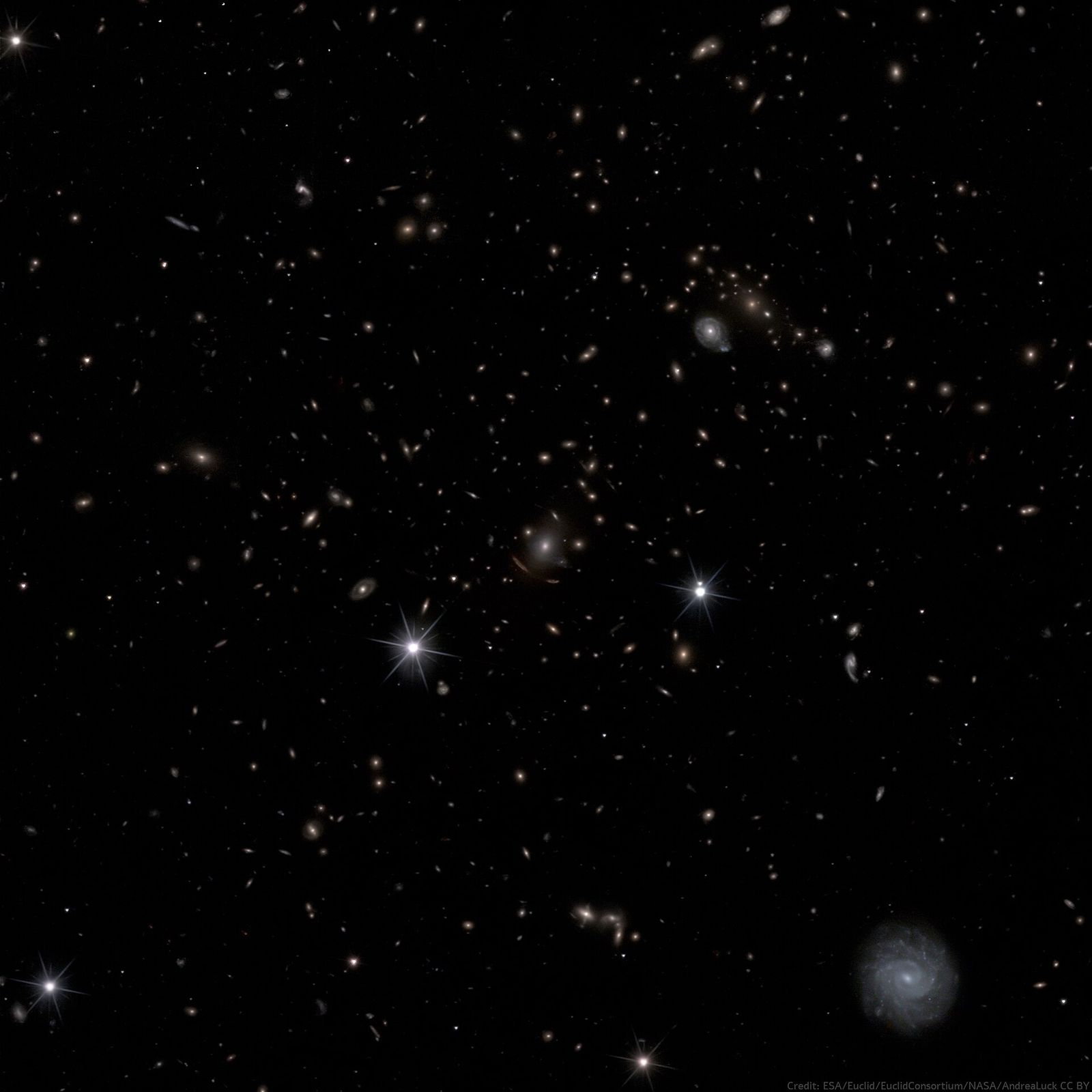
Euclid was not designed to hunt quasars. ESA launched it in 2023 to study dark energy and dark matter, which together make up about 95% of the universe's matter-energy budget. To do that, its Wide Survey images huge numbers of galaxies across a large share of the sky and tracks how their shapes and distribution change over cosmic time.
That breadth is what made the discovery possible. Dún Aonghasa turned up among millions of objects in the survey's first 18 months of data. Euclid only flagged it as a candidate, though. Follow-up work by the W.M. Keck Observatory, the Large Binocular Telescope, the Hubble Space Telescope and, most importantly, the James Webb Space Telescope confirmed what it was. Webb's spectroscopy fixed the redshift at 8.129, give or take 0.005, and supplied the measurements used to estimate the black hole's mass.
This division of labor looks like the template for the next several years. Webb is extraordinarily sensitive, but it sees only a tiny patch of sky at a time. Very luminous early quasars are rare, so someone has to search wide areas to find them. Euclid can scan for the rare bright targets, and Webb can then confirm them in detail. The approach is already paying off: Euclid has found at least a dozen other quasars dating back around 13 billion years.
The team took the nickname from a prehistoric stone fort that stands on a cliff on Inis Mór, an island off Ireland's Atlantic coast. The choice is meant to mark the quasar's place at the outer edge of what astronomers can currently observe.
A black hole too big for its pace
A quasar shines because a supermassive black hole is pulling in gas and dust. The infalling material collects in a disk, heats up and glows so intensely that a quasar can outshine every star in its host galaxy combined. That brightness lets telescopes see Dún Aonghasa at such a distance. It also gives researchers a way to estimate both its mass and how fast it is growing.
Growth rates are often compared with the Eddington limit. At that point, the outward push of radiation from the infalling material balances the black hole's gravity, and above it radiation wins out. Some early black holes appear to have fed at or beyond that rate. Dún Aonghasa is below it. The authors write that building a black hole of several hundred million solar masses so quickly at its current pace requires "either a massive seed or sustained, highly efficient early growth."
The researchers suggest that the black hole may have gone through an intense growth spurt and then slowed down. In that case, astronomers are seeing it after its fastest feeding phase ended or paused. That is plausible, but it means the evidence for how the black hole got so big lies in a period no one has observed.
Wolf framed the trade-off simply in a press release. The closer to the Big Bang these quasars appear, he said, the faster their black holes must have grown, or "the more massive they must have been at birth — or both."
The "born big" option has several candidates, none proven. One is a direct-collapse black hole, which forms when a huge gas cloud collapses without first forming stars. Another is a chain of runaway collisions among stars in extremely crowded clusters. A more speculative idea is primordial black holes, which would have formed in the universe's first moments. Physicists have not shown that primordial black holes exist. If they did exist, they could have given later giants a head start without requiring extreme feeding rates.
What the record does and doesn't cover
The record needs some precision. Dún Aonghasa is the most distant confirmed luminous quasar. It is not the most distant black hole known. Webb has identified fainter active galactic nuclei, including the compact objects nicknamed "little red dots," out to a redshift of about 11. Dún Aonghasa is brighter in ultraviolet light than those Webb-selected objects at similar distances. That brightness puts it in a separate, rarer class, and it is why the redshift 8 milestone matters for quasar research specifically.
The step is also modest in absolute terms. The previous quasar record, reported in 2021, sat at a redshift of about 7.6. The new object moves the frontier back by about 39 million years, which is roughly 6% of the universe's age at that time. That is a real gain, but it is incremental. It does not show that astronomers have reached the beginning of the quasar era.
Quasars at this distance are useful beyond the black hole question. Their light passes through the gas between galaxies on its way to Earth. That lets researchers measure how opaque that gas was during reionization, when early stars and galaxies were burning away the neutral hydrogen that filled the young universe. The same light can show how quickly heavier elements were spreading. Bright early quasars also tend to sit in the densest regions of the early cosmic web. They can help test why black hole masses and host galaxy masses tend to rise together, a link that has no settled explanation.
A single object cannot settle any of these questions. It shows that a black hole this large existed at this point in time and was feeding at this rate. It cannot show how typical that behavior was.
How many more Euclid might find
Researchers have projected that Euclid could find 8 to 23 quasars beyond a redshift of 8. If the real number lands near the high end, astronomers would have enough objects to compare growth histories instead of reasoning from one example. A count near the low end would itself be informative, because it would suggest that giants like Dún Aonghasa are genuinely rare.
Co-author Silvia Belladitta of the Max Planck Institute for Astronomy expects the next record could come soon. "And this may happen sooner than we think," she said, pointing to how quickly Euclid is expanding the list of distant quasars.
Her colleague Eduardo Bañados, also a co-author, said it is unclear how far back luminous quasars go. He added that Euclid "has a good chance of finding out what that limit is." Finding that limit could prove more valuable than any single record. Knowing where bright quasars stop appearing would tell theorists how much time early black holes had to grow and how much of a head start they needed.
Sources
- Universe Today — Space: Euclid's Record-Setting Quasar Probes Black Hole Formation
- Live Science — Science: James Webb and Euclid telescopes discover record-breaking black hole at the edge of the universe
- Space.com — Space: Astronomers discover the most distant and ancient supermassive black hole-powered quasar in the universe
Isaac Tan
Isaac Tan covers biology, biodiversity, and research into the variety of life on Earth. His work follows discoveries about species, evolution, and the connections between organisms and their environments. He explains the evidence behind new findings and the questions they raise, bringing context to developments from genetic studies to ecosystem research.
View all stories