Amber fossils suggest long-legged grasshoppers skated across ponds 100 million years ago
A newly named insect family shows physics, anatomy and a crowded chunk of resin pointing to a lifestyle no living grasshopper has. It also appears to have rowed in an unusual way.

· 6 min read
Key Takeaways
- Researchers named a new extinct family, Hydrelcanidae, from wingless, stilt-legged grasshoppers in roughly 99-million-year-old Myanmar amber.
- Calculations indicate surface tension could hold up roughly 70 to nearly 80 times the insects' estimated body weight, a ratio close to modern water striders.
- One amber piece holds at least nine individuals, adults and nymphs together, which the team calls the oldest documented group behavior in grasshoppers and their relatives.
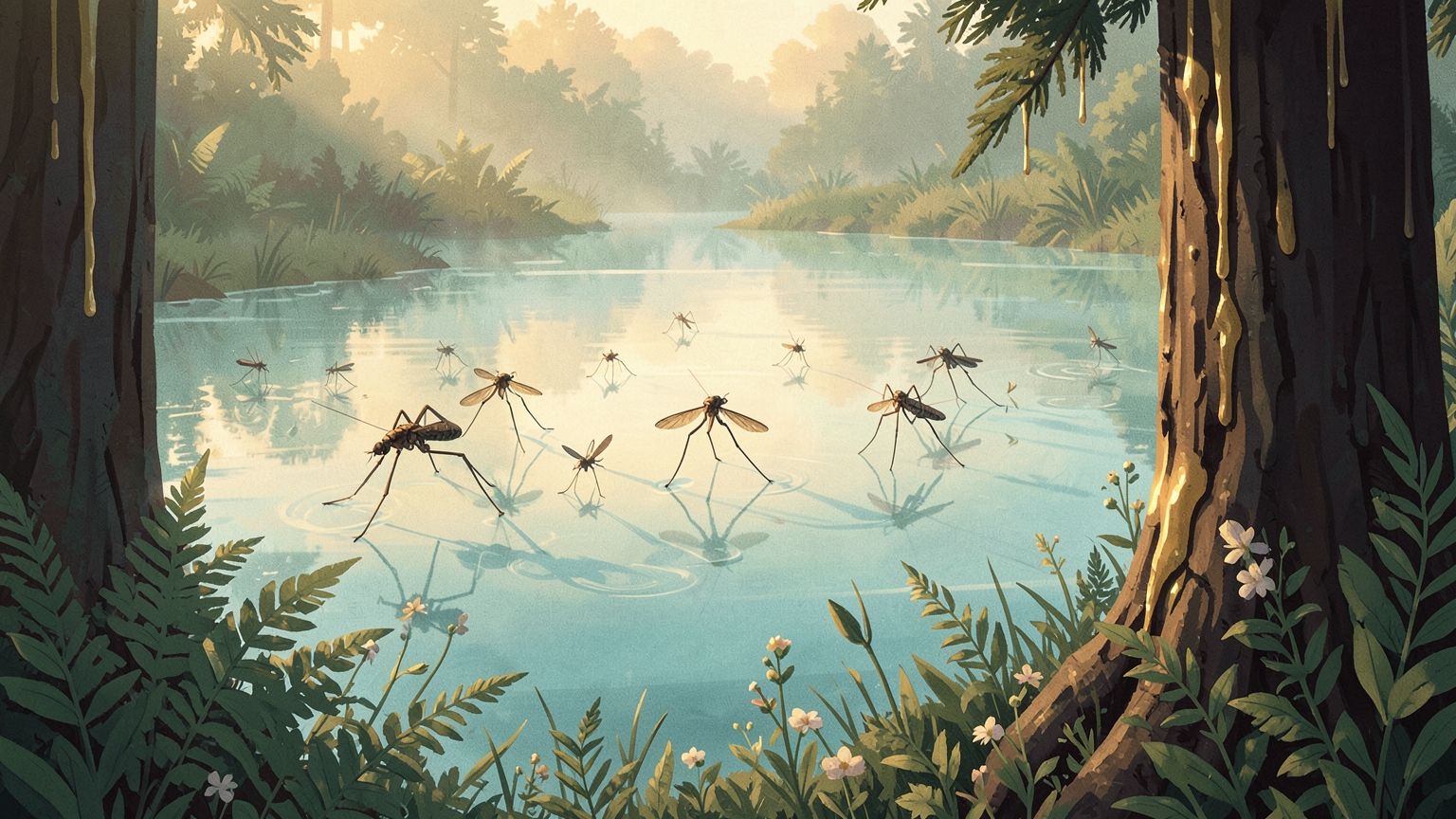
Grasshoppers are built to jump, not to float. A set of fossils preserved in amber from the age of dinosaurs suggests that at least one extinct branch of the family gave up the leap and took to the surface of the water instead, gliding across it on legs so long and thin that the lead researcher first mistook the animals for something else entirely.
The insects, named Hydrelcana zhangi and placed in a newly described family called Hydrelcanidae, come from mid-Cretaceous amber mined in Myanmar's Kachin region and dated to roughly 99 million to 100 million years ago. The team reported on Nov. 24 in Proceedings of the Royal Society B that the animals' anatomy, their body proportions and the physics of their weight all point to a life spent standing and moving on the water's surface tension.
If the interpretation holds, it adds a third independent lineage to a very short list. Only two insect groups were previously known to have specialized for living on the water surface: the living water striders and their relatives, and an unrelated, long-extinct family called Chresmodidae.
The work was led by postdoctoral researchers Chunpeng Xu and Cihang Luo of the Nanjing Institute of Geology and Palaeontology, part of the Chinese Academy of Sciences, with Rolf G. Beutel of Friedrich Schiller University Jena in Germany and Thet Tin Nyunt of the Myanma Gems Museum.
A body plan unlike any known insect
The specimens, found in three pieces of amber, are wingless grasshoppers with short bodies and three pairs of extremely long, slender legs that are nearly equal in length. Xu said that because of the odd shape he initially took them for harvestmen or stick insects rather than grasshoppers.
"I was genuinely amazed," Xu told Science News. "They are among the most bizarre insects."
Two features drew the researchers' attention. The front feet carry a dense, regularly arranged brush of hairs, which the team interprets as water-repellent. The lower hind legs bear slender, leaf-shaped spurs that look like paddles. Modern water striders rely on similar tricks: water-repellent hairs that keep their feet from breaking through the surface, and long limbs that spread their weight over a wide area.
That kind of resemblance can mislead, since unrelated animals sometimes converge on similar shapes for different reasons. What makes this study more persuasive than a description of strange legs is that the team tried to test the idea three separate ways.
Testing the water-walking idea
First, the researchers built what they describe as the first comprehensive matrix of physical characteristics for the superfamily Elcanoidea, an extinct group of grasshopper relatives. Two different methods of reconstructing the family tree both placed Hydrelcanidae as the closest relatives of Elcanidae. That anchors the new insects firmly among the grasshoppers and their kin, rather than among the true bugs that include water striders.
Second, they measured body size and the lengths of leg segments, including the femur, tibia and tarsus of all six legs, across 195 living and fossil insect species. Those species were sorted into six lifestyle groups, among them surface dwellers, ground dwellers, cave dwellers and mimics. Statistical analysis placed Hydrelcanidae squarely among the extinct water-walking Chresmodidae and well apart from the ground-dwelling, cave-dwelling and mimic groups. In plain terms, the fossils are shaped like insects that lived on water and unlike insects that lived anywhere else in the comparison.
Third, the team ran the physics. For two measured specimens, the estimated upward force from the bending water surface came to about 222.78 and 157.46 dynes, compared with estimated body weights of about 3.20 and 2.03 dynes. That works out to a surface force roughly 70 to nearly 80 times each insect's weight, a margin the researchers say is close to the ratio seen in living water striders. From a hydrodynamic standpoint, they concluded, H. zhangi could have stayed on top of the water without sinking.
Each line of evidence has limits on its own. Body proportions show resemblance, not behavior, and the force calculations depend on weight estimates for animals that died 100 million years ago. Together, though, they make a stronger case than any one could alone. The paper's language reflects that balance: the conclusions are framed as reconstructions and probabilities, not observations, and readers should take them the same way.
A different way to row
The fossils also suggest the grasshoppers moved differently from any known water-walking insect. The common pond skater, Gerris lacustris, rows with its middle legs. The researchers propose that Hydrelcanidae instead pushed off with their hind legs, using the paddle-like spurs to grip more water and generate thrust, while the front and middle legs most likely kept the body steady. They named this previously unknown style of movement the rear synchronous stroke gait.
That fits the grasshopper inheritance neatly. Jumping grasshoppers already concentrate power in their hind legs, so a lineage repurposing those legs for paddling is a plausible evolutionary path, even if the reconstruction rests on anatomy rather than any direct record of motion.
Diet appears to have set them apart, too. Modern water-walking insects are predators and scavengers. Based on the mouthparts and the absence of claws, the researchers think the ancient grasshoppers were probably plant eaters as well.
"Walking on water is a pretty rare skill in nature," Xu said. The fossils suggest it was a skill that evolved more than once in the Mesozoic, and by animals with very different lifestyles.
A crowd caught in resin
One large piece of amber holds at least nine identifiable individuals, four adults and five nymphs, along with a jumble of loose legs. The delicate limbs are remarkably intact, which the team reads as a sign the insects were not carried far or battered before resin engulfed them. That points to a group that was together in life, not a pile of remains swept into one spot.
Because juveniles and adults appear side by side, the researchers rule out a mating swarm. They suggest the insects gathered on the water either to feed on a concentrated food source or for safety in numbers against predators. They describe it as the oldest documented aggregation behavior in Orthoptera, the order that includes grasshoppers and crickets. Science News reported the team's view more cautiously, calling it possibly the earliest such record.
Of all the findings, this one may be the most valuable precisely because it is direct. Behavior almost never fossilizes. A single chunk of amber freezing a mixed-age group in place offers rare physical evidence of how extinct insects lived together, even if the reason they gathered remains an inference.
The researchers place the discovery within what paleontologists call the Mesozoic Lacustrine Revolution, the expansion of lakes and freshwater plants after the end-Permian mass extinction, which was followed by a burst of diversification among aquatic insects in the Triassic. Water striders, Chresmodidae and now Hydrelcanidae each arrived at water walking separately during the Mesozoic, which the team takes as a sign that lake surfaces of the era were busy, thriving habitats.
That is the broader payoff. Three unrelated lineages solving the same physics problem in different ways, with different legs and apparently different diets, suggests the water's surface was a rewarding place to live long before the first modern pond skater appeared.
Sources
Felix Rodriguez
Felix Rodriguez covers Earth science, climate research, and the processes that shape the planet. His work follows findings about rocks, oceans, atmospheric systems, and environmental change. He focuses on explaining timescales, measurement methods, and the relationship between individual studies and the wider evidence, helping readers interpret developments across interconnected fields.
View all stories