Hera finds DART left a stadium-size crater and set asteroid Dimorphos tumbling
Europe's probe got the first close look at NASA's 2022 impact site. The moonlet was reshaped, knocked out of its steady spin and ringed by hundreds of boulders.
 By Meera Joshi
· 5 min read
Key Takeaways
- The DART impact flattened one face of Dimorphos into a crater spanning the asteroid's full width.
- Dimorphos, once thought to keep one face toward Didymos, is now tumbling in its orbit.
- Hundreds of meter-scale boulders are orbiting the asteroid pair, and the mission team must plan around them.
- Hera moves to about 13 kilometers in December and releases two cubesats in January.
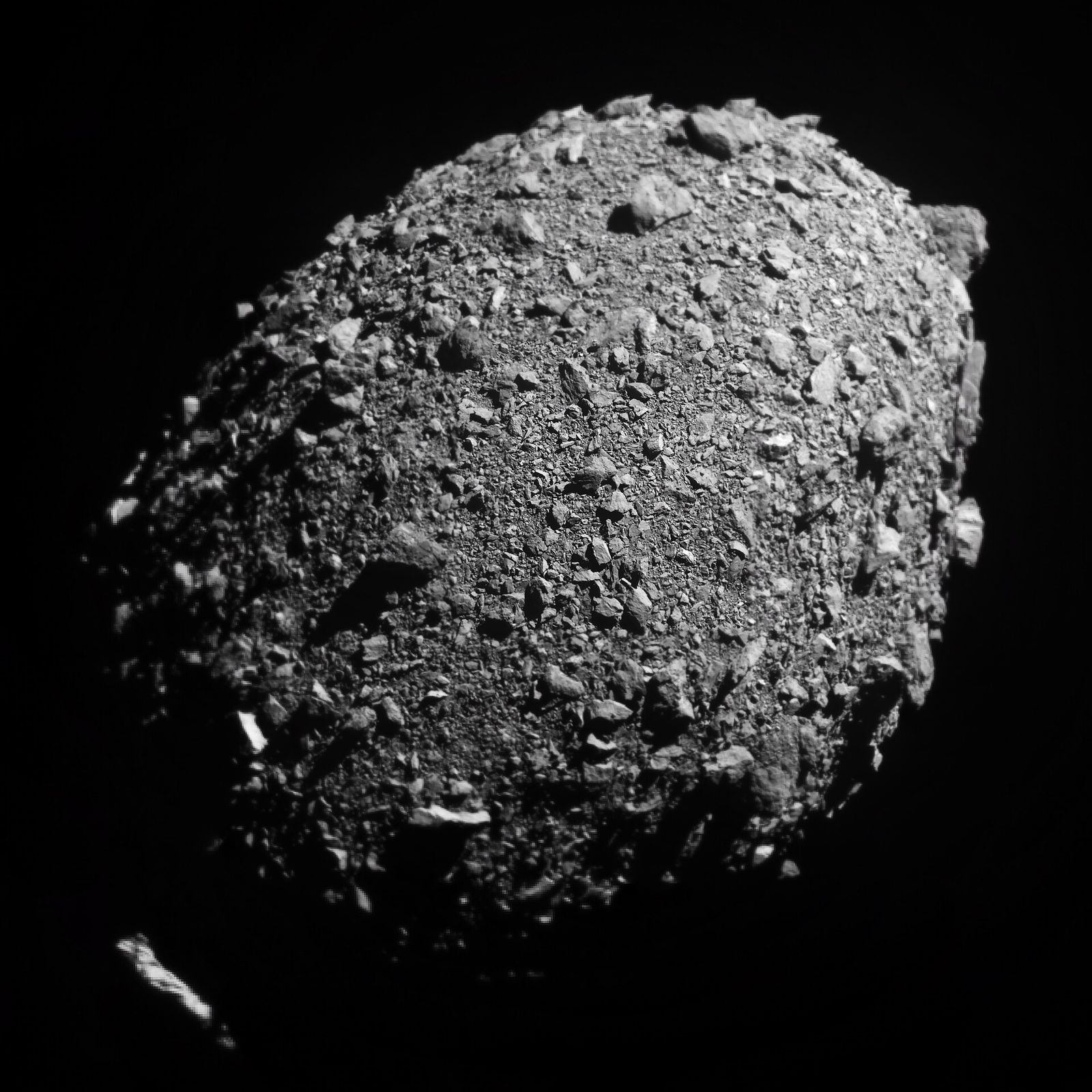
NASA's DART spacecraft did more than nudge the small asteroid Dimorphos when it slammed into it in 2022. It flattened one side, carved a crater stretching across the whole body and left the moonlet tumbling, according to the first close-up images from the European Space Agency's Hera probe.
The findings were unveiled Wednesday, Nov. 25, at the dinosaur hall of the Museum für Naturkunde Berlin in Germany. The setting was a deliberate nod to the asteroid that ended the age of dinosaurs. Hera, which launched in October 2024 and reached the Didymos-Dimorphos system this month, is the first spacecraft to inspect the aftermath of humanity's first planetary defense test.
The pictures answer a question that had hung over DART for four years. Scientists had argued over whether the impact dug a crater, reshaped the asteroid or left it largely unchanged. Patrick Michel, Hera's principal investigator, of the Observatoire de la Côte d'Azur, said the answer was all of the above.
"Much to our surprise, the answer turns out to be all three at once!"
The face DART struck is now a crater roughly the size of a sports stadium. Because the crater runs the full width of Dimorphos, the asteroid's once-rounded profile has gone flat on that side. Elsewhere, the terrain looks much as it did in the images DART sent back before it hit. Researchers comparing the two sets of pictures have recognized individual boulders that seem never to have moved.
That mix of wreckage and preservation is the most interesting part of the result. Dimorphos is a rubble pile, a loose collection of rocks held together by extremely weak gravity. Simulations published in 2024 suggested that an impact like DART's might not leave a clean crater at all and might instead reshuffle the whole body into a new shape. Hera shows something in between: a dramatic local scar on a body whose far side barely noticed. Any model of how rubble piles respond to an impact will now have to reproduce both outcomes at once.
A moonlet knocked out of step
The deeper changes concern how Dimorphos moves. Before the collision, it was thought to be tidally locked to its larger partner, Didymos, keeping one face turned toward it the way the moon does with Earth. That is no longer the case.
Michael Kueppers, ESA's Hera mission scientist, said "it became clear that the DART impact has left Dimorphos tumbling wildly in its orbit."
Hera also found the pair surrounded by hundreds of boulders a few meters across, all in orbit around the system. Kueppers called them another big surprise and said the team will have to account for them as Hera moves closer in the coming weeks. The ESA team has not said where these rocks came from. In 2023, the Hubble Space Telescope spotted a swarm of 37 boulders that appeared to have been knocked loose by the impact, and later simulations suggested some ejected rocks could stay bound to the system long enough for Hera to find them. If many of the new boulders turn out to be DART debris, the impact threw off far more material than Hubble could see.
That would matter well beyond this one asteroid. Debris blasted off an asteroid acts like a rocket exhaust, adding to the push from the impactor itself. Part of the reason DART beat expectations may lie in that recoil. Pinning down how much material left, and how fast, is central to judging how hard a future impactor would need to hit.
DART's headline success was never in doubt. NASA had set a minimum goal of shortening Dimorphos' orbit around Didymos by 73 seconds. The actual change was about 33 minutes, and the pair's path around the sun shifted as well. But an Italian companion craft, LICIACube, could not see the surface through the cloud of debris, and it was gone long before the dust cleared. Until Hera arrived, nobody knew what the asteroid itself looked like afterward.
Hera mission manager Ian Carnelli of ESA framed the two missions as halves of one experiment. "NASA's DART mission demonstrated that we can change an asteroid's orbit," he said. "Hera is now revealing what happened to the asteroid itself."
Closer passes and two cubesats
Hera is holding station about 30 kilometers (18.6 miles) from the asteroids, using its thrusters to fly a box-shaped path around them. In December it is scheduled to close to about 13 kilometers (roughly 8 miles) for sharper images.
In January, it plans to release two shoebox-size cubesats. Juventas will use low-frequency radar to probe the inside of Dimorphos, which would be the first radar measurement of an asteroid's interior, and will later try to land on the moonlet to measure its gravity. Milani will study the asteroids' materials and the dust around the system.
The goal of all this is a precise mass for Dimorphos. Combined with the measured change in its orbit, that number will show how efficiently DART transferred its momentum to the asteroid. It is the figure planners would need if a real threat ever turned up, since it tells them how big and fast an impactor must be to move a body of a given size.
The scale here is modest. Dimorphos is about 151 meters (roughly 495 feet) across, and Didymos about 730 meters (2,395 feet). Neither poses any danger to Earth. DART hit Dimorphos about 11 million kilometers (6.8 million miles) away, choosing the smaller body because its orbit around Didymos would change measurably and could be tracked from ground telescopes.
The tumbling and the boulder swarm make Hera's job harder. Close passes now have to be planned around hundreds of orbiting rocks, and a moonlet that no longer keeps a steady face is harder to map. They are also the most useful complications the mission could have found. A deflection strategy built on the assumption that an asteroid simply absorbs a push and moves on would have missed both effects.
The lesson so far is mixed but encouraging. Kinetic impact works, and on a rubble pile it works better than the minimum target demanded. But it also scars, spins and sheds the target in ways that are hard to predict from simulations alone. Whether DART's extra push came mostly from the spacecraft or from the rock it blew loose is now the main question for Juventas and Milani to help settle in January.
Sources
- ScienceAlert — Space: NASA Crashed a Spacecraft Into an Asteroid. 4 Years Later, We Can Finally See The Carnage.
- Space.com — Space: Hera spacecraft gets 1st up-close look at stadium-sized hole punched in asteroid by NASA DART mission
- Space.com — Space: Watch live: Europe unveils 1st close-up views of asteroid Dimorphos after NASA's DART impact
Meera Joshi
Meera Joshi writes about wildlife, animal behavior, and the relationships that shape ecosystems. Her coverage follows studies of species and habitats, with attention to how researchers gather evidence in changing environments. She connects new findings with broader ecological questions while explaining the limits of individual observations and the significance of longer trends.
View all stories