An hour-long flicker in 2019 may point to a black hole older than the stars
Swinburne astronomers say an unseen object about three times the Moon's mass briefly magnified a distant star. It could be a rogue planet or a relic of the Big Bang.
 By Meera Joshi
· 4 min read
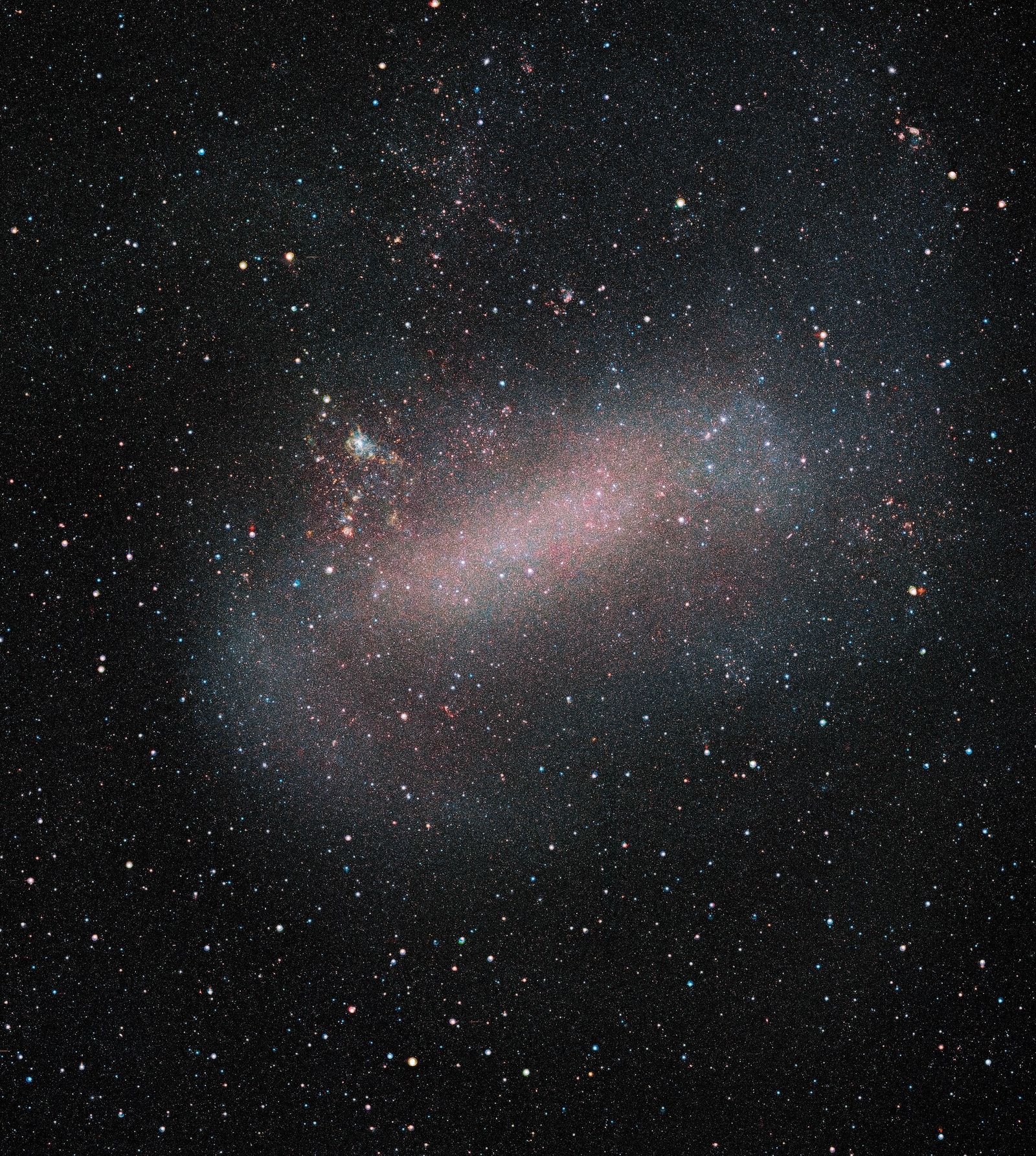
A star in a neighboring galaxy brightened for about an hour in late 2019 and then went back to normal. Astronomers at Swinburne University in Melbourne say something invisible drifted in front of it, and one of the three candidates they have identified is a black hole formed in the first instant after the Big Bang.
The team calls the object Phoebe. From the event, the researchers estimate its mass at roughly three times that of the Moon. They have not determined what it is. The other two candidates are a lone planet wandering through the Milky Way and a similar wandering planet inside the Large Magellanic Cloud, the satellite galaxy where the star sits.
That uncertainty matters as much as the exotic option. One brief signal can't settle Phoebe's identity, but even the more ordinary explanations would make it an unusual find.
On Dec. 18, 2019, the star's light rose gradually for about an hour and then fell away just as gradually. The curve was smooth and symmetrical, with no flare or explosive spike. The star has shown no change in brightness since.
That pattern is the signature of gravitational microlensing, an effect that follows from Einstein's general theory of relativity. When a compact, massive object passes almost exactly between Earth and a distant star, its gravity bends the starlight and briefly makes the star look brighter. The shape of that brightening differs from what variable stars, stellar flares or passing asteroids produce. The Swinburne team found the event in data from a survey that observed stars in the Large Magellanic Cloud at frequent intervals, and the clean profile convinced them it was a real lensing event.
The galaxy is a natural place to look. In the 1990s, survey teams monitored millions of its stars for exactly this kind of flicker, hoping to catch dark matter in the form of dim, compact bodies in the Milky Way's halo. Phoebe extends that long hunt to much smaller masses.
The length of a lensing event depends partly on the mass of the object doing the lensing. Lighter objects generally produce shorter events, although the object's speed and position also affect the timing. Phoebe's event lasted about 60 minutes, close to the shortest that current surveys can detect, and the team's models put the object at roughly three lunar masses.
That is lighter than any planet in the solar system. It is also far too light to be a black hole made the usual way. Black holes that form when massive stars collapse typically weigh at least about five times as much as the sun. An object of a few lunar masses falls absurdly short of that.
If Phoebe is a black hole, then, it can't have come from a dead star. That leaves the primordial route: an idea, which Stephen Hawking helped develop in the 1970s, that extremely dense pockets of the infant universe collapsed directly into black holes within a fraction of a second after the Big Bang. Such objects would predate the first atoms and the first stars, and could have roamed unseen for roughly 13 billion years.
The researchers also asked where the lens most likely lives. They weighed three populations: stars in the Milky Way, stars in the Large Magellanic Cloud, and objects belonging to the dark matter halo that surrounds them. By their calculation, Phoebe is about 100,000 times more likely to belong to the halo population than to one tied to ordinary stars.
That ratio is the most striking number in the work, and it is easy to read too much into it. It describes the lens's probable location and motion, not its makeup. It strengthens the case for a link to dark matter without showing that Phoebe is a primordial black hole, a caveat that comes with the work itself.
Several things should temper excitement. Microlensing events don't repeat; the alignment that produced this one is gone, so no follow-up telescope can go back and look again. The mass estimate rests on models, and because speed and distance also shape the event's duration, a different combination of those factors could push the answer up or down. An event near the edge of what surveys can detect leaves little room for error. The summary of the research published so far also gives no journal citation, so outside scientists can't yet check the modeling in detail.
Even the planet options would be notable. A rogue planet inside the Large Magellanic Cloud would be the first planet found by microlensing outside the Milky Way. Either way, a free-floating world lighter than Mercury would add to the evidence that small bodies get flung out of young planetary systems.
The more interesting question is whether Phoebe has company. Primordial black holes have long been floated as a possible ingredient of dark matter, and if a population of them exists in this mass range, hour-long blips should show up again and again as surveys watch more stars more often. A single event is a curiosity. A steady rate of events with similar durations would be something physicists could test against their theories.
Until then, Phoebe is best understood as a well-measured anomaly: a one-hour signal from late 2019 that fits a rogue planet, fits a relic of the Big Bang, and doesn't yet tell the two apart.
Sources
Meera Joshi
Meera Joshi writes about wildlife, animal behavior, and the relationships that shape ecosystems. Her coverage follows studies of species and habitats, with attention to how researchers gather evidence in changing environments. She connects new findings with broader ecological questions while explaining the limits of individual observations and the significance of longer trends.
View all stories