Voyager 1's next test is power, not distance, as its 50th anniversary nears
One light-day from Earth, the probe loses about 4 watts a year. NASA's team expects no major operating changes until both Voyagers turn 50 next year.

· 5 min read
Key Takeaways
- Mission managers expect no major operating changes until after both probes' 50th launch anniversaries in August and September.
- Each Voyager loses about 4 watts a year from a power supply that started at 470 watts in 1977.
- Voyager 1 stopped responding to commands for about 48 hours last month before recovering.
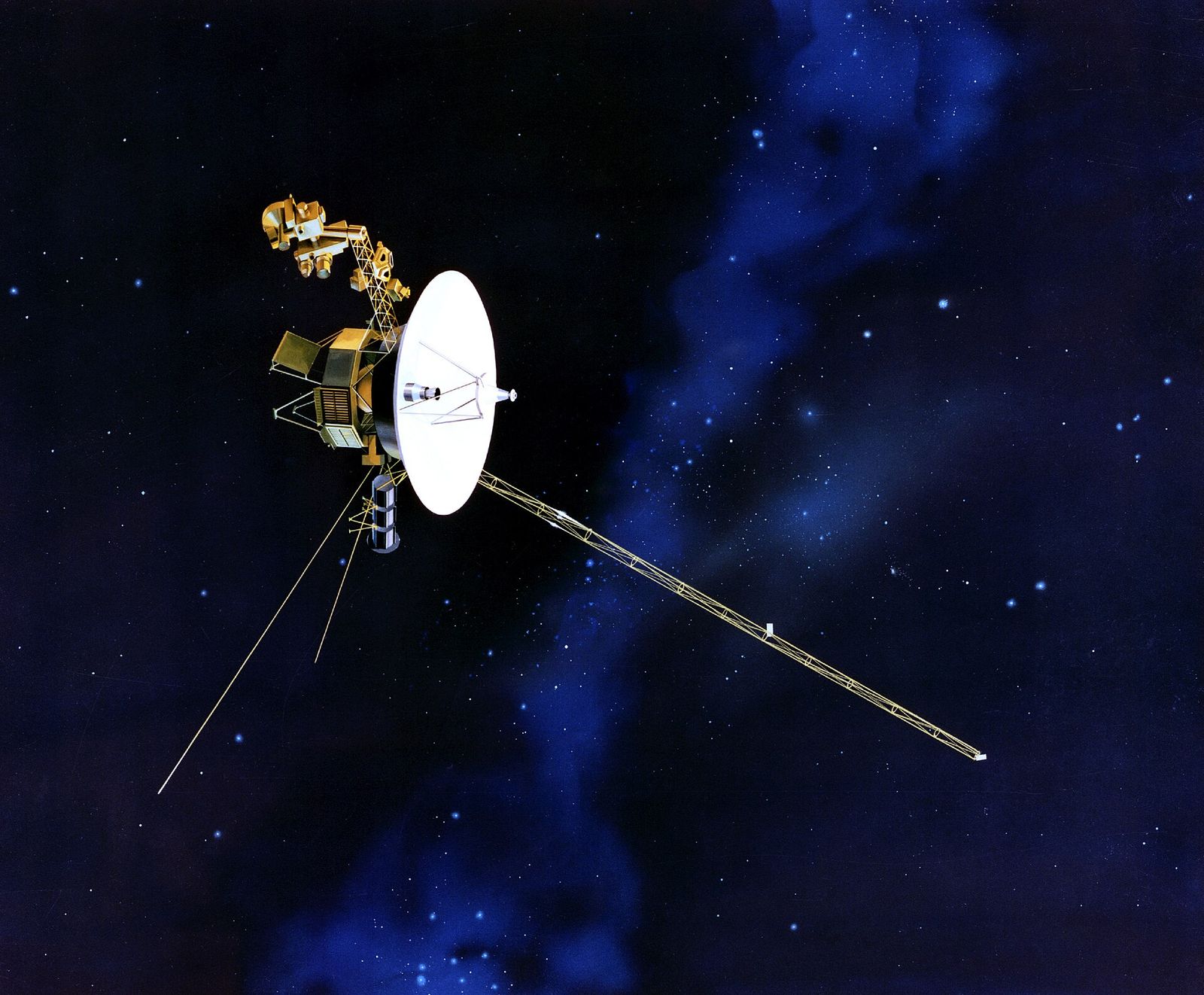
NASA's Voyager team does not expect to make major changes to how either Voyager probe operates until both have passed their 50th launch anniversaries next August and September, project manager Suzanne Dodd told Space.com. Power margins on both spacecraft keep shrinking, so that is a modest promise, and a meaningful one.
The outlook comes just after Voyager 1 became the first spacecraft to reach one light-day from Earth, early Wednesday, Nov. 18. At roughly 16.1 billion miles (25.9 billion kilometers) away, a radio signal now needs a full 24 hours to cross the gap in either direction. Sending a command and hearing back now takes two days. The distance makes the headlines, but the probe's dwindling electricity will decide how much more science it returns.
Each Voyager runs on a nuclear power source that converts heat from decaying plutonium into electricity, and that output falls every year. The probes had 470 watts available at launch in 1977. Each now loses about 4 watts a year, and the team has had to shut down instruments along the way to keep the rest running.
Earlier this year, controllers had both spacecraft carry out what the team calls a "Big Bang," a redistribution of power meant to save as much energy as possible without giving up science. A JPL representative said that move should keep the remaining instruments working through the anniversary period, while cautioning that "there is also the thermal state of the spacecraft to balance." The representative described the power margins as "very thin," especially with the probes running so cold in interstellar space.
Live Science, for its part, reported that the two science instruments still working on Voyager 1 are expected to stay on into the 2030s. Read together, the two accounts suggest the team is confident about the next year and hopeful beyond it. That's a reasonable posture for hardware approaching its 50th birthday. Every watt the team gives up now limits what it can keep running later, and the heater-versus-instrument tradeoff only gets harder as the spacecraft cool further.
The JPL representative also pointed to risks the team cannot plan around, citing the recent loss of contact. Last month, Voyager 1 stopped responding to commands for about 48 hours before recovering quickly.
That episode shows why distance matters even if it isn't the main threat. At one light-day, a single round of troubleshooting takes as long as that entire outage did. Engineers diagnosing a fault on Voyager 1 are effectively working with information a day old, on a computer designed in the 1970s, and that lag will only grow.
The team frames its priority as science, not just staying in touch. The goal is to keep the instruments working as long as possible, the representative said, because the farther the probes travel past the heliopause, the more they reveal about how interstellar space changes with distance from it.
The heliopause is the boundary where the sun's outflow of charged particles gives way to the interstellar medium. Voyager 1 crossed it in August 2012, becoming the first spacecraft to reach interstellar space. Voyager 2 followed in November 2018. Its route past Jupiter, Saturn, Uranus and Neptune was slower, and it is expected to reach one light-day of its own in 2035.
Dodd said the current work tracks magnetic field strength and direction, plasma density and energetic particles, with the aim of measuring how all of them shift as the probes move outward. Project scientist Linda Spilker said the team is also watching for solar disturbances, such as shocks and pressure fronts, that still reach the spacecraft. She added that the team wants to follow how the magnetic field around the probes keeps turning from the sun's direction toward the interstellar one. Scientists did not expect that behavior when the Voyagers launched.
"Where does the sun's influence end and pristine interstellar space begin?" Spilker said. "Perhaps Voyager may last long enough to answer that question."
That is the right question to hang the mission's remaining years on. No other operating spacecraft is placed to answer it, and the answer depends entirely on how long the instruments last.
Keeping the probes alive is also a staffing problem. JPL mission manager Kareem Badaruddin said the Voyager team now includes several generations of engineers. Its most junior members, Nshan Kazaryan and Bhavana Gupta, are being prepared for larger roles. Kazaryan negotiates tracking time with NASA's Deep Space Network, the system of large antennas used to communicate with distant missions. Gupta has compiled documentation from the spacecraft's command and control systems so the team has detailed instructions on hand if problems arise.
"They have demonstrated their value to the team consistently," Badaruddin said. He credited senior team member Jack Lippincott with deep knowledge of Deep Space Network operations and data interpretation, which helped the team handle problems caused by recent severe weather at one of the antenna sites.
This may be the least visible risk to the mission and among the most important. Much of what keeps the Voyagers running lives in the heads of people who have worked with these machines for decades. Writing that knowledge down and passing it to younger engineers looks like the smartest investment the project can make for spacecraft that can never get new hardware.
The probes have earned that effort. Voyager 1 recorded the first volcanic eruption seen beyond Earth, on Jupiter's moon Io, and found a thin ring around Jupiter made partly of dust from Io. At Saturn, it discovered five new moons and showed that Titan's haze was thick enough to hide the surface completely. In 1990, it took the solar system "family portrait" that included the Pale Blue Dot image of Earth, then switched off its camera for good.
"What Voyager has taught me is to expect the unexpected," Spilker, who joined the team in 1977, told Live Science. She said the probes repeatedly proved scientists' theories wrong.
For now, the plan is to reach the 50th anniversaries without major changes. The harder question is Voyager 2's light-day in 2035. That date is nearly a decade away, and at 4 watts a year, the probe will lose roughly another 35 watts of power before it gets there. Badaruddin noted that no spacecraft had ever been in contact with Earth from this distance before Voyager 1, adding that "it may never happen again." Whether Voyager 2 can still be heard in 2035 will show whether he was right.
Sources
Theo Anderson
Theo Anderson covers astronomy, space discoveries, and the observations expanding our picture of the universe. His work follows telescope findings, planetary research, and the questions behind new results. He explains the tools and concepts involved, placing striking images and announcements in context so readers can understand what scientists have learned.
View all stories