Leonid meteor shower peaks this week under dark skies, with forecasts split
The crescent moon sets before midnight, leaving the pre-dawn hours dark. One forecast calls for about 15 meteors an hour; NASA says fewer than three.
 By Hannah Bell
· 4 min read
Key Takeaways
- Published peak dates differ: the American Meteor Society says Nov. 16-17; the International Meteor Organisation, cited by Space.com, says Nov. 17-18.
- Hourly rate estimates run from about 15 under ideal dark skies down to fewer than three from NASA.
- Jupiter and Mars sit a few degrees apart in Leo on the peak night, making the radiant easy to find.
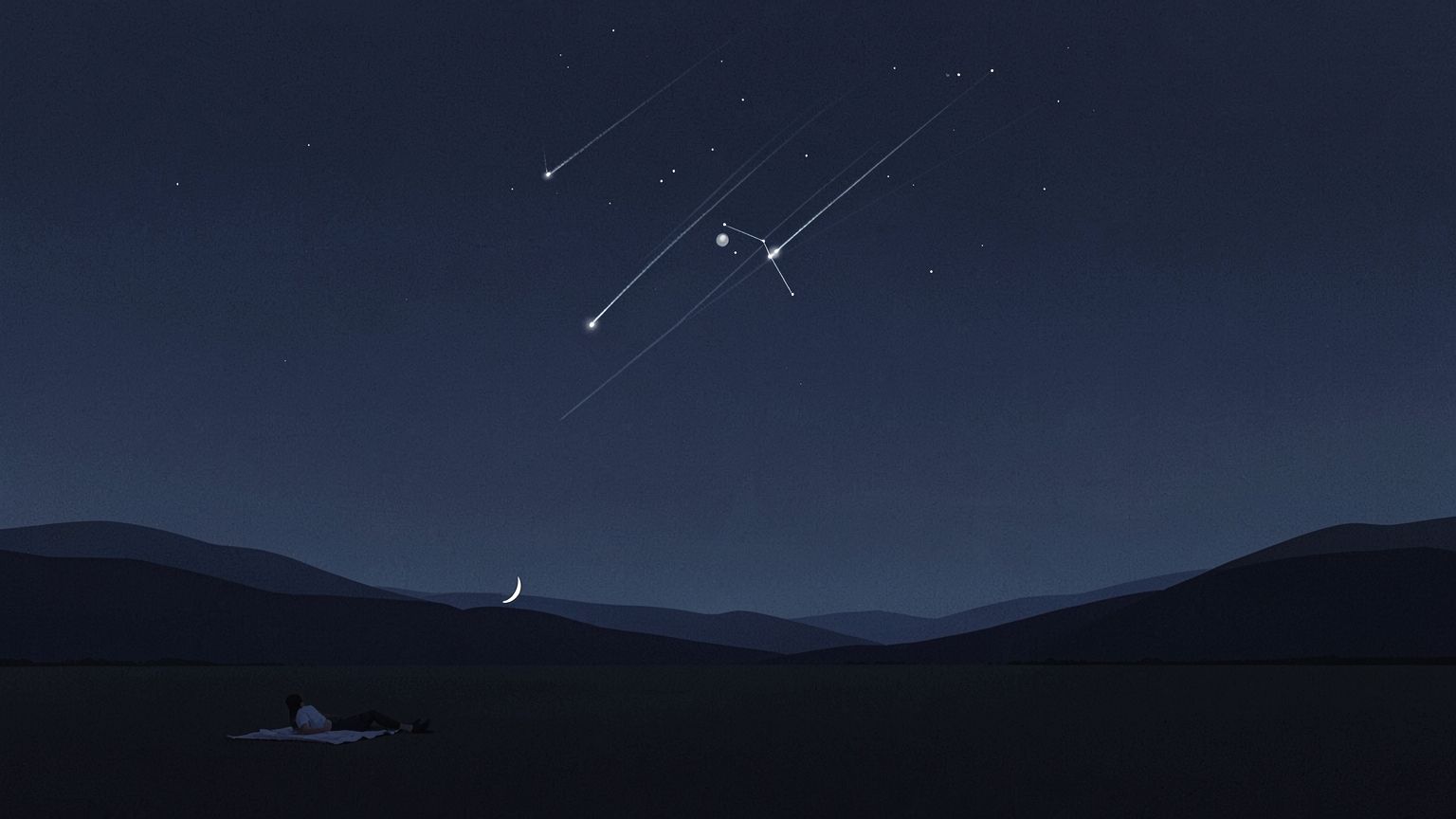
The Leonids peak with a helpful coincidence: a 45%-lit waxing crescent moon that sets just before midnight, leaving the hours after midnight properly dark. What nobody can promise is the number of shooting stars, and the published forecasts for this peak disagree by a wide margin.
The American Meteor Society puts the peak on Monday night into Tuesday, Nov. 16-17, and the shower typically produces roughly 15 meteors an hour under ideal conditions. A second outlook, from the International Meteor Organisation and reported by Space.com, also gives a 15-per-hour ceiling but dates the peak a night later, Tuesday into Wednesday, Nov. 17-18. Both accounts were published Nov. 16, so they cannot both be describing the same night.
NASA's estimate is more sobering: fewer than three meteors an hour.
That spread is not a scandal. Meteor counts depend on which of the comet's debris trails a model weights, how high the radiant climbs before dawn and how much artificial light you are sitting in. The practical reading is that 15 an hour is a ceiling for a genuinely dark site, not a schedule. Twelve to fifteen an hour works out to one meteor every four or five minutes, and plenty of those will be faint enough to miss if you are checking your phone.
The cheapest fix for the calendar problem is to watch both nights and concentrate on the small hours before dawn, when Leo is highest and the moon is long gone. Midnight is when a session starts, not when it peaks.
A moonless window matters more than a big headline rate. With the crescent out of the sky, fainter meteors that a bright moon would wash out become visible, which is why a modest forecast on a dark night can beat a richer one under moonlight.
Finding the radiant is easy this year. Leo glistens above the southeastern horizon before dawn, and Jupiter and Mars sit just a few degrees apart within the constellation on the peak night, bright enough to pick out from a suburb. Point your gaze a little away from Leo rather than straight at it. Meteors arriving close to the radiant hit the atmosphere nearly head-on and leave the shortest trails; a bit farther out, the same particles cut across the sky at a slant and draw long, slower-looking streaks.
Fast, bright and occasionally spectacular
The Leonids earn their reputation on speed. The particles strike the atmosphere at about 43 miles per second (70 kilometers per second), among the fastest of any annual shower, and often burn bright enough to leave a glowing trail. The shower also throws off fireballs and Earth-grazing meteors, which enter at a shallow angle and skim the upper atmosphere, sometimes for many seconds, before passing back out into space.
All of it comes from Comet 55P/Tempel-Tuttle, a body about 2.2 miles (3.6 kilometers) wide that circles the sun roughly every 33 years and sows a fresh ribbon of dust on each pass. Its last visit to the inner solar system was in 1998, and it is due back in 2031.
Storm forecasts that split, again
Those 33-year returns are what make the Leonids famous. When Earth crosses a particularly dense ribbon of the comet's debris, the shower stops being a shower: storms in 1833, 1866, 1966, 1999, 2001 and 2002 produced bursts of about 1,000 meteors an hour, according to the American Meteor Society. Nothing of that kind is expected this year.
When the next one arrives is where the sources part ways. Live Science reports the next storm is expected in 2099. Space.com, citing the Planetary Society, says one could come as early as 2031, and notes a study published in August 2026 that points to potentially spectacular displays in 2033 and 2034. The gap between those two forecasts is nearly seven decades, which says plenty about how narrow the debris ribbons are and how much the answer depends on the model. Watch the comet's 2031 return; if a storm is coming that decade, the modeling should tighten well before then.
For a night out this week, the routine is simple. Get away from streetlights, lie back with as much open sky as you can frame and give your eyes 20 to 30 minutes to adjust; a screen resets that clock. Leave the binoculars and telescope indoors, since both reduce the sky to a keyhole when a shower rewards the widest possible view. A phone on a small tripod can catch a bright meteor, though luck does most of the work.
The realistic expectation is a slow, cold, occasionally thrilling hour. Fifteen meteors an hour spread across the whole sky is not a light show, and anyone who quits after ten minutes will probably see two or three. The argument for staying is the fireball: the Leonids produce enough of them that one bright, fragmenting streak can justify the whole night.
Anyone who wants volume rather than speed should mark Dec. 13-14, when the Geminids peak at up to 120 meteors an hour, spawned by an asteroid rather than a comet, with a slim crescent moon that sets shortly after dark. By the numbers, that is the better night of the year.
Sources
Hannah Bell
Hannah Bell writes about physics, experimental discoveries, and the ideas used to describe the physical world. Her coverage explores how researchers test theories, interpret measurements, and investigate unresolved questions. She makes unfamiliar concepts approachable while distinguishing what an experiment demonstrates from the possibilities it may open for future research.
View all stories