Astronomers may have caught a giant star swallowing its companion in Andromeda
Years of slow brightening, then a late-2025 outburst tracked by Webb, fit a long-predicted stellar merger. The lead researcher says another outcome is still possible.
 By Isaac Tan
· 4 min read
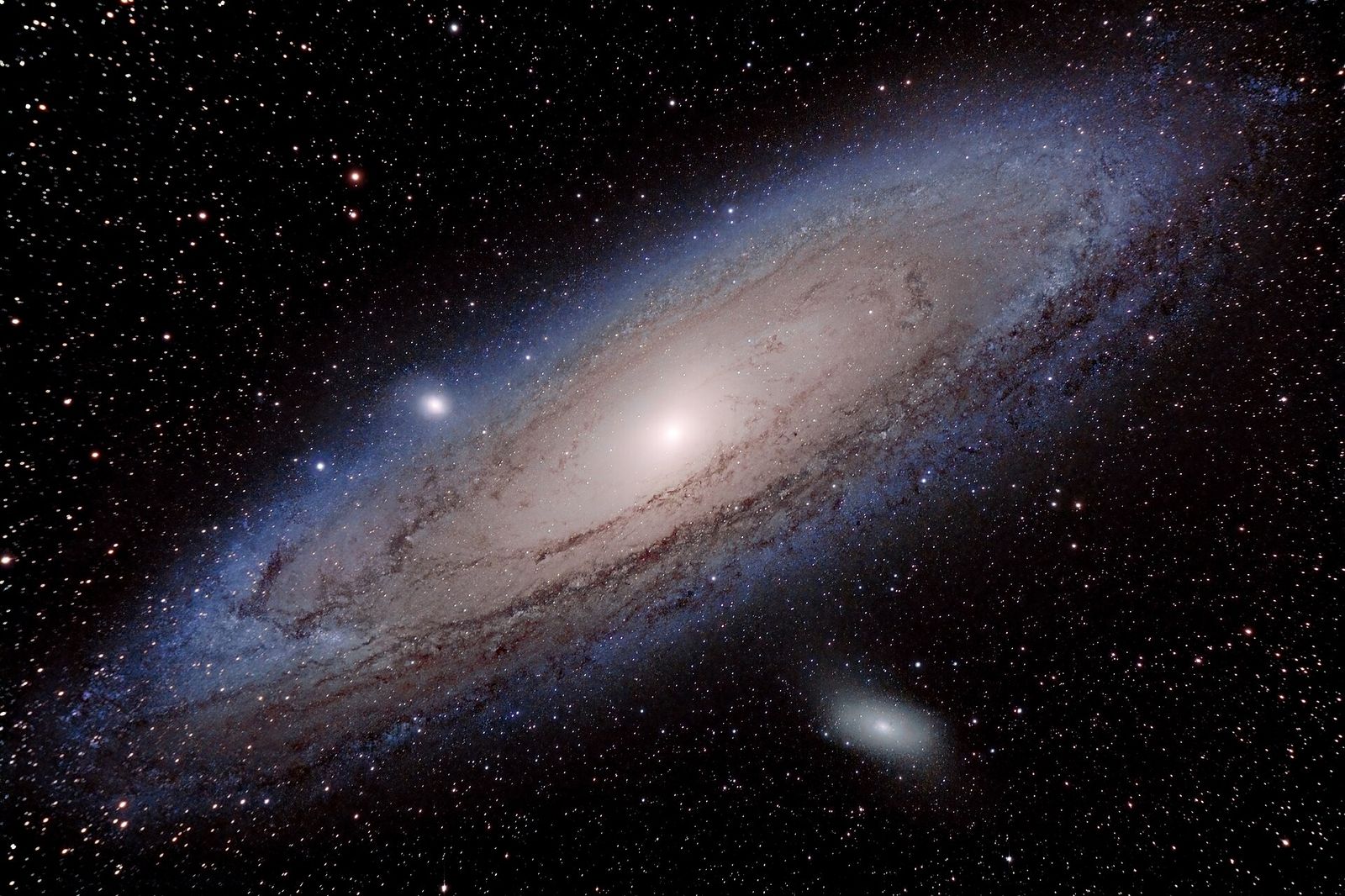
Astronomers say they may have watched a dying giant star engulf a companion star, a process that theory has described for decades but no one had directly observed before. The study, published Nov. 18 in the journal Nature, focuses on a red giant in the Andromeda galaxy that brightened gradually for years and then let loose a large outburst of light near the end of 2025.
The star, cataloged as WNTR23bzdiq, lies about 2.5 million light-years from Earth. It has roughly seven times the mass of the sun and stretches about 350 times as wide. The researchers have nicknamed the two-star system "Bao."
Stars near the end of their lives balloon to hundreds of times their earlier size, and anything orbiting close enough gets swallowed. In a binary system, that can mean one star absorbing its partner. Seeing it happen is another matter.
"Catching a star engulfing its companion in the act is very difficult," lead author Viraj Karambelkar, an astrophysicist at Columbia University, told Space.com. The signal, he said, is faint against everything else a star is doing: "its effect is very subtle — like throwing a bucket of water in a large ocean." Spotting it requires sensitive instruments that watch the same patch of sky for years.
A slow glow, then a burst
That patience is what paid off here. In 2023, the team noticed the star getting brighter in data from NASA's NEOWISE space telescope, which has since been retired, and the WINTER telescope at Palomar Observatory in California. Going back through older records, they found the rise had started slowly in 2018.
The researchers had earlier proposed an explanation: a companion star sinking toward the giant's core through its swollen outer layers. That inward spiral would produce friction and heat, and the extra light would show up as a steady climb in brightness.
Then, late in 2025, the giant erupted. NASA's James Webb Space Telescope observed it just 47 days later, giving the team detailed measurements while the event was still fresh. Their interpretation is that a companion of about 70% of the sun's mass slammed into the giant's center. By their estimate, the blast threw off material totaling about one-tenth to one-fifth of a solar mass.
"I was absolutely flabbergasted when we saw this," Karambelkar said.
What makes the case persuasive is the sequence, not any single observation. A years-long precursor glow followed by a sharp eruption is the pattern a companion grinding its way inward and then hitting the core should produce, and the team proposed the engulfment idea before the outburst arrived. A prediction followed by a confirming event carries more weight than an explanation fitted after the fact. Webb's quick turnaround mattered too: catching the debris within seven weeks gives modelers far more to work with than a look months or years later would.
A merger, or a tighter orbit
Karambelkar was careful about how far the result goes. He said this event provides the first observations of a long-standing theoretical prediction, but the merger reading "is not the only possibility."
"The other possibility is that both stars survived, in a much shorter orbit," he said. Settling the question, he added, will mean keeping watch on the system after the eruption fades.
That caveat deserves weight. The "first" in this story rests on an interpretation, and the alternative isn't a minor footnote. If both stars came through, Bao would be a different kind of object: a binary that shed a large amount of gas and drew much closer together, rather than a single star built from two. Either outcome is scientifically valuable, but they are not the same discovery.
Both scenarios bear on one of the murkier steps in stellar astrophysics. Theorists have long argued that when one star swallows another, the pair passes through a brief phase sharing a single bloated envelope of gas. Depending on how much of that gas is ejected, the pair either merges or ends up locked in a much tighter orbit. That phase is commonly invoked to explain how compact stellar pairs form, including the kinds that can later produce exploding white dwarfs or merging neutron stars. Models of it have relied heavily on theory, so a measured ejected mass from a real event is the kind of number researchers can actually test against.
The limitation is obvious: this is one system, observed in another galaxy. A single case can confirm that something happens, but it can't show how often or under what conditions. Karambelkar is counting on the next generation of sky surveys to fix that, naming the Nancy Grace Roman Space Telescope and the Vera Rubin Observatory as tools that should turn up many more of these events.
"I can't wait to find more," he said.
There's a reason this is worth watching beyond the specialists. The sun will swell into a red giant in roughly 5 billion years, though with no stellar companion its victims will be inner planets rather than another star. For Bao, the next step is less dramatic: watching what remains once the outburst clears, to learn whether one star or two is left behind.
Sources
Isaac Tan
Isaac Tan covers biology, biodiversity, and research into the variety of life on Earth. His work follows discoveries about species, evolution, and the connections between organisms and their environments. He explains the evidence behind new findings and the questions they raise, bringing context to developments from genetic studies to ecosystem research.
View all stories