Sanrivatti's One hypercar seats its driver astride the car like a motorcycle rider
The Dutch startup's track-only single-seater pairs an 800-hp Judd V-10 with a forward-leaning posture it says shows far more of the road. Nobody has seen the cockpit yet.

· 5 min read
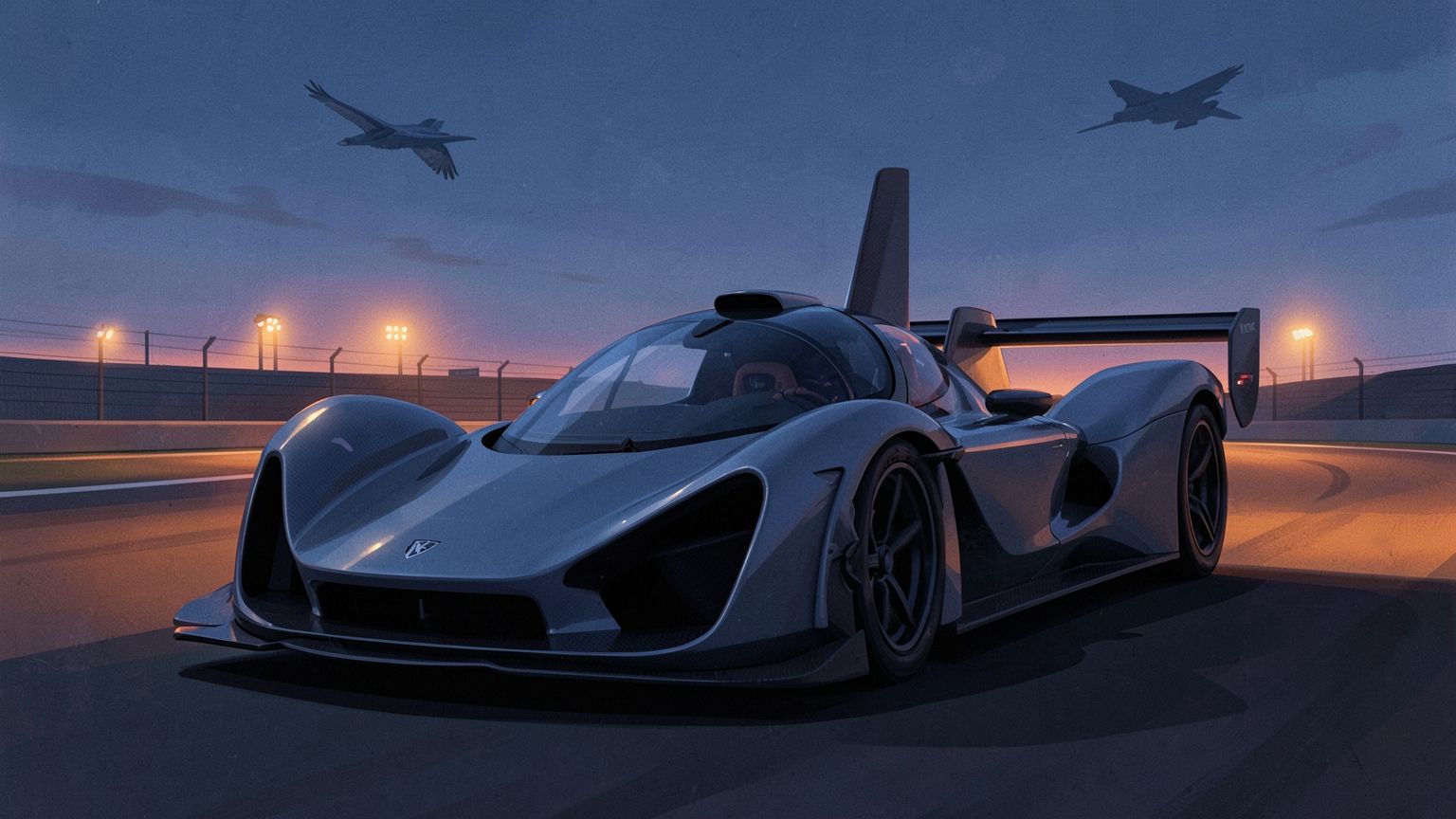
Dutch hypercar startup Sanrivatti has detailed the One, a track-only single-seater in which the driver sits astride the car's central spine. The posture is closer to a superbike rider's than to anything in a conventional cockpit: torso forward, legs extended behind.
The company calls the layout the Apex Position. The driver still uses a steering wheel and foot pedals for throttle and brake, but pushes those pedals rearward rather than forward. Sanrivatti says the driver can also lean into corners while keeping hold of the wheel. The startup first showed the One as a concept with few details and has now released fuller specifications and design information.
That is a genuinely unusual idea. Single-seat track cars are a familiar niche, but they have almost always kept the driver in a conventional seated position. Sanrivatti is asking buyers to relearn how to drive, and it presents that learning curve as part of the appeal.
A Judd V-10 and race-grade hardware
The powertrain is less experimental than the seating, and that is probably a good thing. Power will come from a naturally aspirated 5.5-liter V-10 supplied by Judd, the British racing engine builder with a long history in Formula 1, IndyCar and Le Mans. Projected output is 800 horsepower, sent through a Hewland six-speed sequential gearbox, another name drawn straight from motorsport.
Sanrivatti puts the car's weight at about 1,100 kilograms, roughly 2,425 pounds, and estimates top speed at more than 200 mph. Those figures are projections, not measured results. If the car reaches them, the power-to-weight ratio would put it in serious company. The chassis is a carbon-fiber monocoque under carbon-fiber bodywork. AP Racing supplies the brakes, Braid the forged magnesium wheels, and Michelin racing-grade Pilot Sport tires.
Choosing a high-revving, naturally aspirated V-10 over a hybrid or electric setup is a clear statement. Several boutique makers have bet their identity on old-school combustion engines, and for a car meant to deliver sensation rather than lap-time bragging rights, a screaming V-10 fits the brief. Partnering with established suppliers like Judd and Hewland also makes sense for a startup. It spares the company from developing an engine and transmission in-house, a job that has sunk more than one small manufacturer.
Designed around what the driver can see
The body follows from the seating position. Lead designer Robin van Tilborg drew on two references: the diving posture of a peregrine falcon and the shape of fighter jets. The result is a cab-forward shape with a central, canopy-like driver compartment and wraparound glass. Low bodywork flanks the canopy, deep air channels run along the waist, a vertical fin rises behind the driver, and a large wing wraps around the whole rear of the car.
Sanrivatti says the main reason for the layout is forward visibility. The company has been developing the One with physical and virtual simulators and a proof-of-concept model. It says that in virtual testing at Corner Three of Britain's Silverstone Circuit, the Apex Position showed on average 3.2 times more visible track surface than 10 benchmark hypercars and track cars evaluated at the same spot.
That is a striking number, but readers should keep its limits in mind. It comes from the company's own simulation, at a single corner, against cars Sanrivatti has not named. Better sightlines are a plausible benefit of putting the driver's head farther forward and higher on the centerline. Whether that turns into a better experience on a real track depends on things a simulator measures poorly: comfort over a full session, how the posture handles heavy braking, and how confident drivers feel leaning into a corner at speed.
Founder and CEO Santiago Sánchez Rivero said the company did not set out to build another car that simply adds power and technology.
"We wanted to question something more fundamental: what it actually feels like to drive."
He described fighter aircraft as the source for the canopy, front intakes and the mix of flowing surfaces and sharp edges, while insisting the styling was not the goal in itself. "The architecture and every line needed to have a reason to exist," he said.
Single-seat track cars have a well-established lineage. Gordon Murray's Rocket for the Light Car Company, the BAC Mono, the McMurtry Spéirling Pure and Ferrari's Monza SP1 all serve drivers who care more about circuit time than about carrying a passenger. The rider-style posture has almost no precedent on four wheels, though. The closest parallel is Italdesign Giugiaro's Machimoto, a 1986 concept that put up to nine occupants on two straddle-style benches. It remained a design study.
The biggest gap in what Sanrivatti has shown is the one that matters most. No interior images have been released, so it is not yet clear how the cockpit, controls and instruments work around a driver lying forward over the spine. A driver in that posture also needs a restraint system very different from a normal racing harness. How Sanrivatti solves that will say more about whether the Apex Position is practical than any rendering or simulator figure.
Making the One track-only gives the company some room here. It avoids the road-car crash and homologation rules that would make an unconventional seating position much harder to approve. The tradeoff is a narrower market: buyers who will trailer a car to circuits and are willing to retrain their instincts to drive it.
That market is unforgiving even for established names. Rimac reportedly ended production of its Nevera electric hypercar at 71 cars, well short of its plan. The details released so far say nothing about the One's price, production volume or delivery timing. For now, the One is an intriguing idea backed by a credible parts list. Its success will depend on what Sanrivatti shows of the cockpit, and on what drivers say once they have actually driven it on a track.
Sources
Harper Lawson
Harper Lawson writes about vehicle ownership costs, used car markets, and maintenance news. Her coverage follows price trends, repair expenses, service developments, and the factors affecting household transportation budgets. She explains reported costs and market comparisons, helping readers understand how depreciation, upkeep, and changing vehicle prices fit into the wider cost of driving.
View all stories