A planet hunt 28 light-years away turned up a triple star system that shouldn't exist
A hidden white dwarf found circling a nearby red dwarf means the small star survived two stellar deaths. Its discoverers can't yet say how.
 By Isaac Tan
· 5 min read
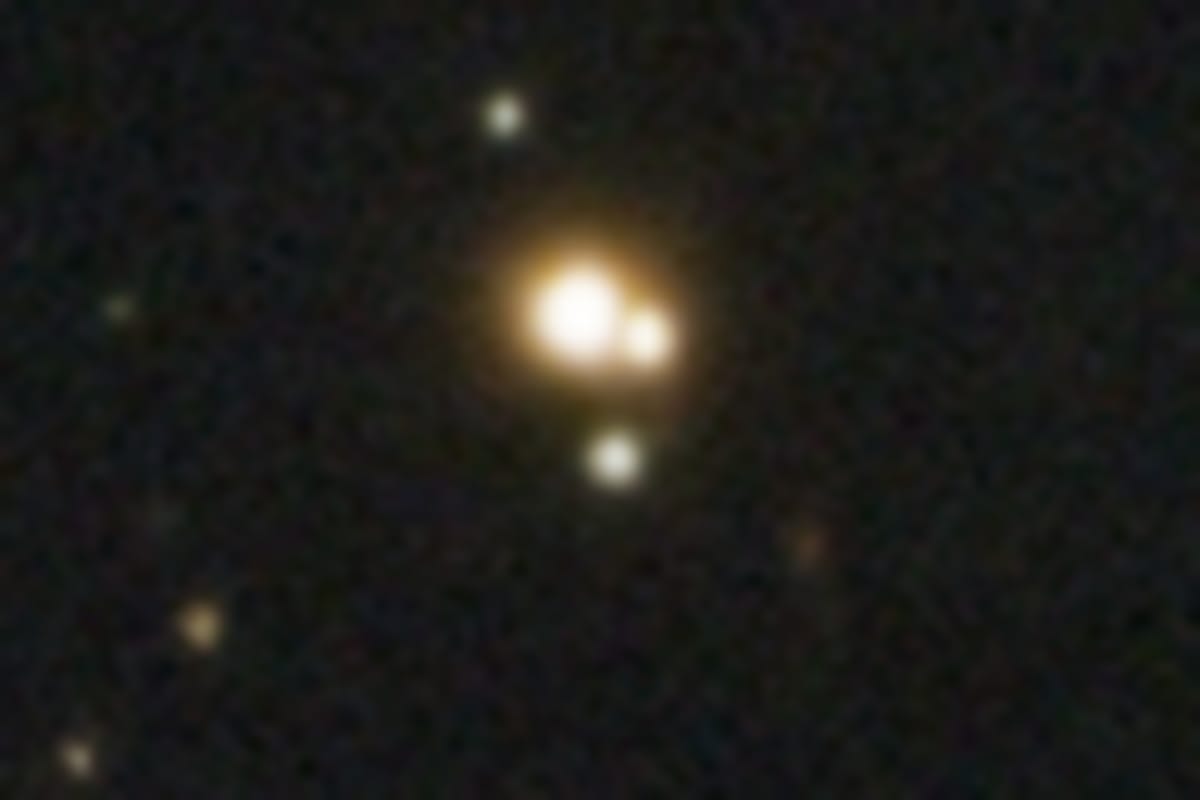
Astronomers looking for planets around a nearby red dwarf found something else: a hidden white dwarf in a tight orbit around it. The find turns a known two-star pairing 28 light-years from Earth into a rare triple system, and its discoverers say the arrangement should not have survived.
The system, named Welopō'ai, holds one small, dim red dwarf and two white dwarfs. White dwarfs are the dense, burned-out cores of dead stars. The team reports no comparable system within at least 100 light-years of the sun. The work was published Nov. 19 in the journal Astronomy & Astrophysics.
"This system should not exist," said Patrick Dufour, a Montreal astronomer on the team. "We have no clean explanation for how it got here."
A wobble far too strong for a planet
Two members of the trio were already on the books. The red dwarf had a known white dwarf companion about 129.3 astronomical units away, roughly 12 billion miles. That companion takes about 1,000 years to complete one orbit. Étienne Artigau of the Trottier Institute for Research on Exoplanets at the Université de Montréal, who led the study, was searching the red dwarf for planets with SPIRou, an infrared spectrograph on the Canada-France-Hawaii Telescope atop Mauna Kea.
"We were actually looking for planets," Artigau said. "Instead, we found something much more surprising."
SPIRou finds planets indirectly. A star and an orbiting planet both circle a shared center of mass, so the star sways slightly back and forth, and that motion shows up as a Doppler shift in its light. A large gas giant might move its star at hundreds of meters per second. An Earth-mass planet manages only tens of meters per second.
The red dwarf was swinging at about 16 kilometers, or 10 miles, per second. That is dozens of times beyond what even a giant planet could produce, so whatever was tugging on the star had to be far heavier. Follow-up observations with the 8-meter Gemini North telescope, also on Mauna Kea, pinned it down as a white dwarf. Charles-Antoine Parent, an undergraduate at Université Laval and a co-author, said the object's high mass and very faint glow left one plausible answer: "it was the remnant of a dead star."
An object with more than half the sun's mass had been sitting unnoticed beside one of the sun's nearer neighbors. That says a good deal about how incomplete the census of the local stellar neighborhood still is. White dwarfs are faint enough that, tucked in close to a brighter companion, they can hide in plain sight. This case shows that a careful planet search can catch them.
How the red dwarf should have been disrupted
The puzzle comes from how white dwarfs form. When a star of roughly the sun's mass runs low on hydrogen in its core, its interior contracts and heats up, and a shell of hydrogen around the core starts fusing. The star swells into a red giant tens or even hundreds of millions of kilometers across. Eventually fusion stops, the outer layers drift off into space, and the core shrinks into an inert, Earth-sized white dwarf, typically with half to two-thirds of the sun's mass.
That means Welopō'ai began as two sun-like stars plus the red dwarf. The red dwarf is still shining because low-mass stars use up their core hydrogen slowly and live far longer than stars like the sun.
The trouble is the inner white dwarf's orbit. It sits only about 4.6 astronomical units from the red dwarf, roughly 428 million miles. Jupiter orbits the sun farther out than that. A red giant badly disturbs its surroundings. Even if the swelling star never reached the red dwarf, the expansion should have unsettled the smaller star's orbit and might have sent it plunging into the giant. Instead, the red dwarf sits in a stable orbit, apparently undisturbed.
It had to survive the death of the outer star too. That one sits far enough away that it was arguably the lesser threat. Still, a small star that lived through two stellar deaths and kept a tidy orbit is the kind of outcome current models don't readily produce. Dufour's admission that there is no clean explanation reads less like modesty than like an honest description of where the theory stands.
"That is the question driving our next observations," Dufour said. The team hopes more detailed measurements of how the three bodies tug on one another will let it reconstruct the system's history and work out how the red dwarf made it through. Because the system is so close, the astronomers can make high-precision measurements that would be out of reach for a more distant trio.
The close inner orbit has already delivered a practical payoff. Because the inner white dwarf and the red dwarf sit so near each other, the team could measure both masses with an uncertainty below 1%. The red dwarf comes in at 42% of the sun's mass and the inner white dwarf at 62%. Working backward, the researchers estimate the white dwarf began life as a star about 40% more massive than the sun.
That precision may prove to be the discovery's most durable contribution. A white dwarf's mass is tied directly to the mass of the star that made it, but in practice those masses are usually poorly pinned down. A white dwarf weighed this precisely gives astronomers a firm benchmark for testing how stars of a given size end up. It also gives physicists a known quantity for studying the matter inside a white dwarf, which is held up against further collapse by electron degeneracy pressure. That pressure gives way only under the stronger gravity that forms neutron stars.
Pairs of white dwarfs are not unheard of. WD 0727+482, a binary white dwarf 37 light-years away, is one example. Finding two of them alongside an ordinary star in a single system is a much rarer arrangement.
The name fits the problem. Welopō'ai blends two Hawaiian words and means a path of family traits. Untangling this family's lineage is exactly what the astronomers now have to do.
"Discoveries like this remind us that our own cosmic neighborhood still contains remarkable surprises," Artigau said. His team set out to find planets and came away with a dead star weighed to within 1%.
Sources
Isaac Tan
Isaac Tan covers biology, biodiversity, and research into the variety of life on Earth. His work follows discoveries about species, evolution, and the connections between organisms and their environments. He explains the evidence behind new findings and the questions they raise, bringing context to developments from genetic studies to ecosystem research.
View all stories