Aptera finally delivers its first customer car after two decades of prototypes
The solar-assisted three-wheeler went to its largest early investor, a long-awaited milestone but a long way from volume production.

· 3 min read
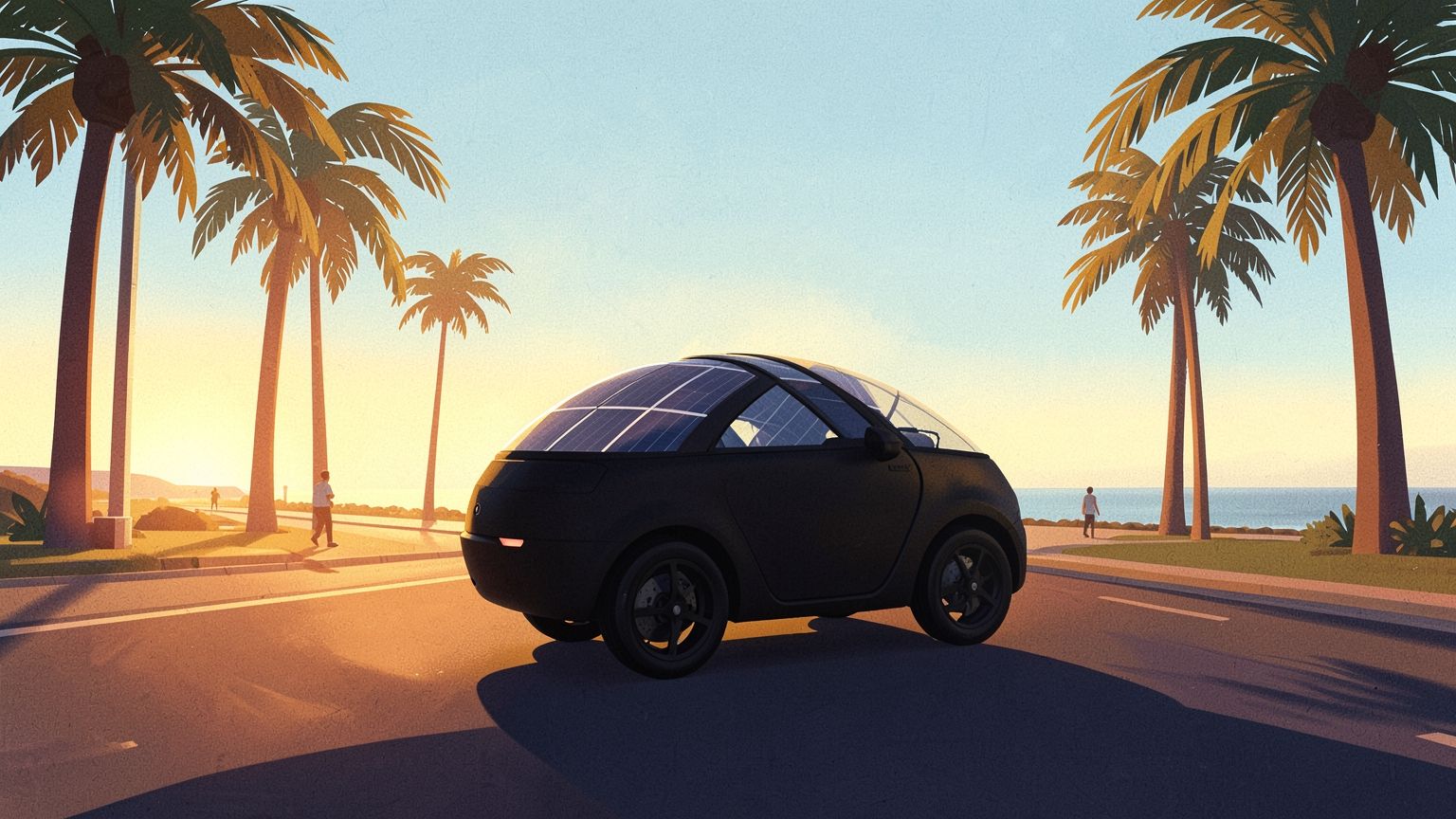
Aptera Motors has handed over its first car to a paying customer, ending a two-decade stretch in which the solar-assisted EV maker produced concepts, prototypes and missed deadlines but no deliveries.
The buyer is Martin Hartono, an Indonesian CEO who is Aptera's largest early investor. That stake put him at the front of the order line for the production car. The car is reportedly headed overseas, presumably to Indonesia, though where it will be driven has not been confirmed.
The buyer matters as much as the delivery. A car going to the company's biggest early backer is a real handover, but it isn't proof that Aptera can build and ship cars to ordinary reservation holders at a steady pace. The more telling sign will be how quickly the second, 10th and 100th cars follow.
Hartono's car is finished in matte black. That makes a shape that already looks like an aircraft fuselage on three wheels look even more unusual. It will almost certainly be the only one of its kind on the road wherever it ends up.
The Aptera seats two and rides on three wheels. It uses a 44-kWh battery pack and charges through the NACS-style connector that Tesla introduced and much of the industry has since adopted. The company lists curb weight at 2,200 pounds. That puts it closer to a Mazda MX-5 roadster than to a mainstream electric sedan such as the Tesla Model 3.
The headline feature is the set of solar panels built into the body. Aptera says they can add up to 40 miles of range per day. That is about a tenth of the car's planned 400-mile total range, which is a company target rather than an EPA estimate.
The solar figure deserves careful reading. "Up to" means ideal conditions: strong sun, a car parked in the open, and the long days of a place like Southern California. Owners in cloudier climates, or who park in garages, should expect less. Still, for a driver with a short daily commute in a sunny region, even part of that figure could mean plugging in far less often. It is one of the few solar-car promises that sounds useful in daily driving rather than like a gimmick.
The rest of the efficiency case is basic engineering. A light car with a slippery shape needs less energy to move, so a modest 44-kWh pack can be stretched further. That is how Aptera can aim for a 400-mile range without the heavy, expensive battery most long-range EVs carry. It is a sensible approach. The open question is whether a two-seat three-wheeler can find enough buyers beyond early adopters and enthusiasts to support the business.
Aptera's road to this point has been unusually long. The original company drew attention in the late 2000s with a teardrop-shaped three-wheeler, then shut down in 2011. The name returned in 2019 under a revived company that went back to the solar-electric concept. Since then it has changed timelines more than once while raising money partly from enthusiasts and small investors.
Against that history, one customer delivery is worth noting. It shows Aptera can build a car complete enough to hand over and ship. It does not show the company can build cars profitably or in volume, and a single delivery does nothing to change its finances.
Electric-vehicle startups tend to struggle most in the stretch after the first car, when production has to scale, suppliers have to keep up, and early quality problems show up in owners' hands. Aptera has cleared the milestone it chased for 20 years. The next one, delivering cars to the reservation holders who aren't its biggest investor, will say far more about whether the company has a future.
Sources
Julian Morales
Julian Morales follows automakers, vehicle manufacturing, and the supply chains behind the cars reaching dealerships. His coverage connects factory plans, production figures, supplier developments, and company announcements with broader industry changes. He explains how manufacturing decisions and parts availability can influence vehicle output, delivery schedules, and the direction of the automotive business.
View all stories