40Hz light-and-sound goggles slowed mild Alzheimer's decline but missed main goal
Cognito Therapeutics will seek FDA authorization for its Spectris device in mild disease after a 663-person trial found no benefit in moderate patients.
 By Amara Okafor
· 5 min read
Key Takeaways
- The 12-month HOPE trial of 663 people did not meet its primary endpoint across the full study population.
- In the 395 patients with mild Alzheimer's, decline slowed 47% to 56% on three standard measures compared with controls.
- The 268 patients with moderate Alzheimer's showed no clinical benefit.
- Cognito plans to seek FDA authorization for mild Alzheimer's only.
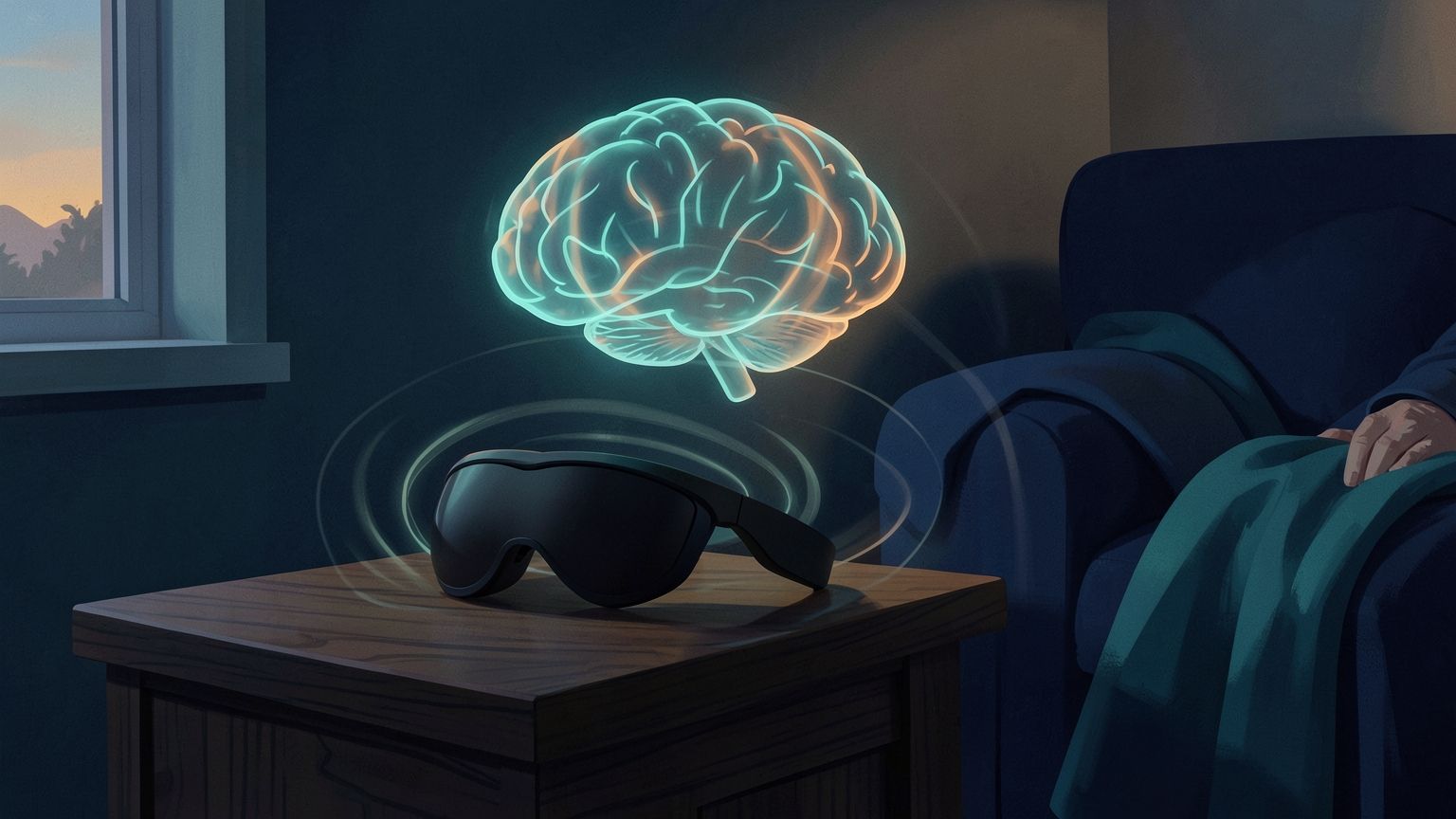
A pair of goggles that flash light and play sound at 40 pulses per second slowed the decline of people with mild Alzheimer's disease in a yearlong national trial, its maker said, even though the study as a whole fell short of its main goal.
Cognito Therapeutics, a Cambridge, Massachusetts, company spun out of MIT, presented results of its HOPE trial on Nov. 16 at the Clinical Trials on Alzheimer's Disease conference in Boston. The company said it will ask the Food and Drug Administration to authorize the device, called Spectris, for patients with mild Alzheimer's. It did not report benefits for anyone else.
That split result is the heart of the story. A noninvasive, at-home device with no reported safety problems would be a very different option from the infusion drugs now on the market. But the evidence for it rests on a subgroup, and that is where the scrutiny will land.
What the trial found
HOPE enrolled 663 people in a randomized, controlled, double-blind design and followed them for 12 months. Participants were divided into two subgroups set in advance: 395 people with mild Alzheimer's and 268 with moderate disease. Each group was compared with untreated controls.
In the mild group, the company reported statistically significant slowing of decline on three standard scales:
- ADCS-ADL, a measure of daily living: 56% slower decline
- ADCS-iADL, which focuses on more complex daily tasks: 53% slower decline
- CDR-SB, a widely used rating of cognition and function: 47% slower decline
The numbers rose among the 169 mild patients who used the goggles at least 70% of the intended time. In that group, the company reported slowing of 82% on both daily-living scales and 64% on CDR-SB. It also reported a statistically significant 73% effect on iADMARS, another composite measure.
The moderate group showed no clinical benefit. Even within the mild group, some measures did not reach statistical significance. Taken together, the trial did not meet its primary endpoint. The company said the device was well tolerated, with no unanticipated adverse device effects observed.
Cognito CEO Christian Howell was candid about the miss. The company tested the device as broadly as it could based on earlier feasibility data, he said in a statement. "We had hoped to see an effect across that overall population, and we did not," he said. The company's priority now, he added, is working with the FDA toward authorization of Spectris for Alzheimer's.
How much weight the mild-group result can bear
The company deserves credit for designing the mild and moderate groups before the trial began instead of hunting for a winning slice after the fact. Still, a trial that fails its primary endpoint and succeeds in one arm leaves regulators with a harder call than a clean win. The FDA will have to decide whether the mild-group benefit is strong enough to stand on its own or whether a confirmatory study is needed.
The adherence figures deserve the most caution. Patients who keep up with a daily treatment routine for a year can differ from those who don't in ways that affect how fast their disease progresses, such as caregiver support or general health. The 82% figures may reflect the device working better with consistent use, which is plausible. They may also partly reflect who manages to use it consistently. The trial as described cannot fully separate those explanations.
Readers should also keep in mind where these numbers come from. They were released by the company and publicized by MIT, where the approach was developed, and the researcher most closely tied to it is a Cognito co-founder. That is normal for early announcements of trial results, but the full data, analysis methods and, eventually, peer review will matter a great deal.
Comparisons with the approved amyloid antibody drugs are tempting and should be made carefully. Those medicines are given by infusion and carry a known risk of brain swelling and bleeding that requires MRI monitoring. A pair of goggles worn at home with no reported serious side effects would be far easier to use. But percentages of slowed decline from different trials, populations and durations are not directly comparable, and the mild-group results here have not yet been replicated.
A decade of research in mice
The idea grew out of the lab of MIT neuroscientist Li-Huei Tsai, who co-founded Cognito with MIT colleague Ed Boyden. Gamma brain rhythms around 40Hz are weakened in people with Alzheimer's and in mouse models of the disease. In 2016, Tsai's team reported that exposing mice to 40Hz flickering LED light for an hour a day over a week lowered levels of amyloid, the protein that builds up in Alzheimer's brains.
Since then, her group has published 14 peer-reviewed papers on what it calls GENUS, short for Gamma Entrainment Using Sensory Stimuli. In mice, the team has reported reduced loss of neurons and synapses, lower amyloid and tau, preserved myelin and better memory, using light, sound, both together or vibration. A 2024 study from her lab in mice pointed to a possible mechanism: the stimulation appeared to speed clearance of amyloid through cerebrospinal fluid via the brain's glymphatic system. Independent studies in mice and one in nonhuman primates have since supported that clearance finding.
Human evidence before HOPE was small. A 2022 pilot of 15 people with mild Alzheimer's found that, after three months, those receiving stimulation showed better preservation of hippocampus volume, less enlargement of brain ventricles, improved sleep indicators and better scores on a visual memory test. Cognito's earlier OVERTURE trial, with 76 volunteers, reported no serious adverse events and signs of slower decline in cognition and daily function.
Tsai said the new results show strong evidence that people with mild Alzheimer's can benefit, "especially when they keep up fully with treatment." She added that the finding "parallels what we've seen in mouse models."
That parallel is the most encouraging part of the picture. Many Alzheimer's ideas have looked strong in mice and collapsed in people. Here, a signal survived the jump to a large, blinded human trial, at least in patients earlier in the disease. That fits a pattern seen across Alzheimer's research, where treatments tend to have their best chance before too much damage is done.
Tsai said she plans to keep studying the approach, including in a study of whether it can prevent symptoms in people at risk of Alzheimer's. For now, the device is not authorized, and the next concrete step is Cognito's filing with the FDA. How regulators weigh a strong subgroup against a missed primary goal will decide whether these goggles reach patients or head back for another trial.
Sources
Amara Okafor
Amara Okafor covers community health, access to services, and developments affecting everyday wellbeing. Her work follows research and public information about the conditions that influence health across different communities. She focuses on explaining how services are organized, whom new initiatives may reach, and what the available evidence says about their effects.
View all stories