A single router in Arkansas set off the longest US flight shutdown since 9/11
About 18,000 flights were canceled after contractor work destabilized the FAA's data backbone. The suspect hardware is now in a lab, and the investigation has barely begun.
 By Ethan Kim
· 5 min read
Key Takeaways
- The FAA halted all U.S. departures for more than four hours on Nov. 13 after radio and radar feeds failed across much of the country.
- Investigators are focused on a router installed during L3Harris upgrade work in El Dorado, Arkansas, and a second one in Amarillo, Texas.
- American Airlines canceled about 22% of its schedule from Friday through Monday morning, the most of any carrier, according to Cirium.
A piece of networking hardware installed during maintenance in southern Arkansas is at the center of the investigation into Friday's nationwide ground stop, the longest halt to U.S. flight departures since the Sept. 11 attacks.
The Federal Aviation Administration stopped every takeoff in U.S. airspace at 3:54 p.m. ET on Nov. 13 and did not lift the order until 8:15 p.m. The damage spread well beyond those four-plus hours. About 18,000 U.S. flights were canceled from Friday through Monday morning, according to FlightAware. Hundreds of thousands of travelers were stranded; The Verge put the figure at more than 1.5 million.
By Monday the system was largely back on its feet, with nearly 300 cancellations and close to 1,000 delays, according to FlightAware. That is a small fraction of Sunday's disruptions, but still a reminder of how long it takes airlines to reposition planes and crews after a shock of this size.
How one device took down a national network
The trouble surfaced around 3:15 p.m. ET, when pilots and controllers in the Midwest began struggling to hear each other over the radio. Within minutes, controllers at Quad Cities International Airport in Moline, Illinois, were reporting that the problem reached well beyond their facility. Cockpit audio captured the confusion as it spread. After the ground stop was announced, one United pilot asked a Seattle controller whether "national" meant Reagan National or the entire country.
The failure traces to the FAA Telecommunications Infrastructure, known as FTI, the network that carries voice and radar data among more than 4,400 aviation facilities. Defense contractor L3Harris built it in the early 2000s, and it is due to be replaced in 2028. Until then, L3Harris keeps it running through incremental upgrades.
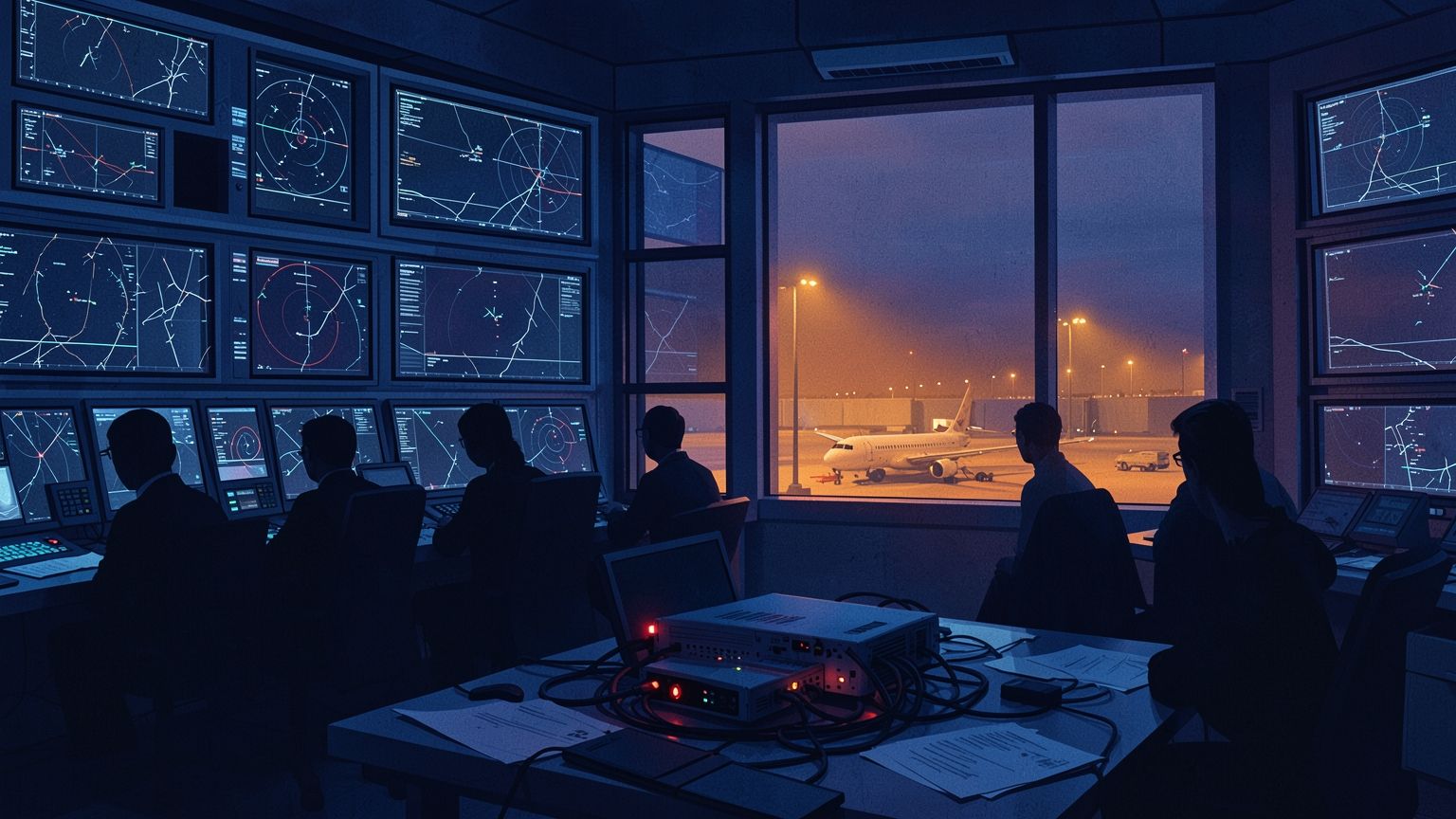
Duffy has tied the outage to a router in southern Arkansas and to work, overseen by L3Harris, to move from copper wiring to fiber optics. FAA Administrator Bryan Bedford described that upgrade as "routine" maintenance. The Wall Street Journal reported that L3Harris contractors had swapped an old wired telephone switch for a new wireless data router at the FAA's radio facility in El Dorado, Arkansas, earlier that day. Once switched on, the router hammered the network with hundreds of connection attempts every second, according to the Journal.
According to The Verge, FAA technicians believe the resulting instability cut radio and radar feeds to 17 of the agency's 22 Air Route Traffic Control Centers, the facilities that handle high-altitude traffic between airports, along with several approach-control facilities. Contractors isolated the El Dorado router and a second one at a radar site in Amarillo, Texas, and the network then began to stabilize. Duffy said Sunday that both routers are now at an L3Harris lab in Florida. The FAA has described the problem as "instability" in data feeds, and the root cause remains under investigation.
I-Hong Hou, an electrical and computer engineering professor at Texas A&M University, offered The Verge a plausible mechanism. Networks chop radio transmissions and radar positions into small packets that have to be reassembled on the other end. If a strained network loses even a modest share of them, he said, a feed can stop entirely. A video call can blur its picture or drop to audio to stay connected. Air traffic control systems demand precise, stable synchronization and have no such fallback, which is how one misbehaving device can trigger failures in the equipment around it.
That is the most unsettling part of this episode. If the Journal's account holds up, the problem wasn't an exotic attack or a wholesale hardware collapse. It was a single new device, added during scheduled work, that a network linking thousands of facilities could not contain. A system that critical should be able to wall off a misbehaving node before it reaches radar feeds in most of the country. The investigation will need to answer why FTI could not do that, and whether the new router was tested before it went live.
Airlines and passengers absorb the hit
American Airlines took the biggest blow, canceling 5,367 flights from Friday through Monday morning, close to 22% of its schedule, according to aviation data firm Cirium. Delta Air Lines canceled 3,434 flights, or 17%, and Southwest Airlines and United Airlines each scrubbed more than 16% of their schedules. Bad weather on Thursday and Friday had already been snarling travel before the ground stop.
Atlanta, Delta's main hub, lost more than 600 departures as the shutdown took hold. Airlines waived change fees and fare differences and offered pilots and flight attendants extra pay to get the schedule back together.
For travelers, that recovery often meant a string of rebookings. Beth Martin, trying to get home to Birmingham, Alabama, from New York's LaGuardia Airport after her daughter's birthday trip, told CNBC the two spent Saturday night at the airport, sleeping in wheelchairs outside security, after their hotel quoted about $700 for another night. Delta eventually rebooked them to Memphis, a four-hour drive from home. Justine Fritz, headed to Minneapolis, tried five flights before getting one to Houston. "It's been bananas," she told CNBC.
Mixed messages from Washington
Officials' public explanations didn't help. The FAA offered almost nothing publicly for roughly six hours after the stop began, according to The Verge's account, beyond a brief press release and one post on X. At 11:30 p.m. ET, Duffy and Homeland Security Secretary Markwayne Mullin held a news conference.
Mullin said flatly that "there is no cyberattack" and suggested that new equipment installed during modernization had overwhelmed the older system. When pressed by a reporter, he softened that, conceding "there's nothing completely certain right now." Duffy said switches and routers had been overloaded with data and had produced inconsistent readings, then added, "I don't want to rule out nefarious activity."
At a Saturday briefing, Duffy raised the possibility that contractor "incompetence" played a role. L3Harris said in a statement that afternoon that it is backing the FAA's investigation into what caused the ground stop. Officials have not made public any evidence of a cyberattack, yet the conflicting statements fed online theories about hackers and about the FAA's new SMART system, which rolled out in September.
Uncertainty in the first hours of an outage is understandable. Declaring a cause with confidence and then retreating from it is a different problem, because it gives speculation room to grow. Given recent safety scares, including the 2025 midair collision near Reagan National Airport that killed 67 people, travelers had reason to want clear, careful answers, and the briefings didn't provide them.
Whatever the investigation finds, FTI remains in service until its planned 2028 replacement, and every upgrade between now and then will be carried out on a system that has just shown how little it takes to bring it down.
Sources
Ethan Kim
Ethan Kim writes about consumer technology, including phones, computers, and connected devices. His coverage examines product announcements, specifications, and the tradeoffs behind new hardware. He focuses on turning technical details into useful context, helping readers understand how devices differ and which changes represent a meaningful step from earlier generations.
View all stories