Dune: Part Three went to a never-filmed Iceland beach and deeper into Liwa
Denis Villeneuve's finale, out Dec. 18, 2026, adds an Icelandic beach never filmed before, 20 UAE desert locations and what its designer calls the largest LED wall of its kind.
 By Nina Patel
· 4 min read
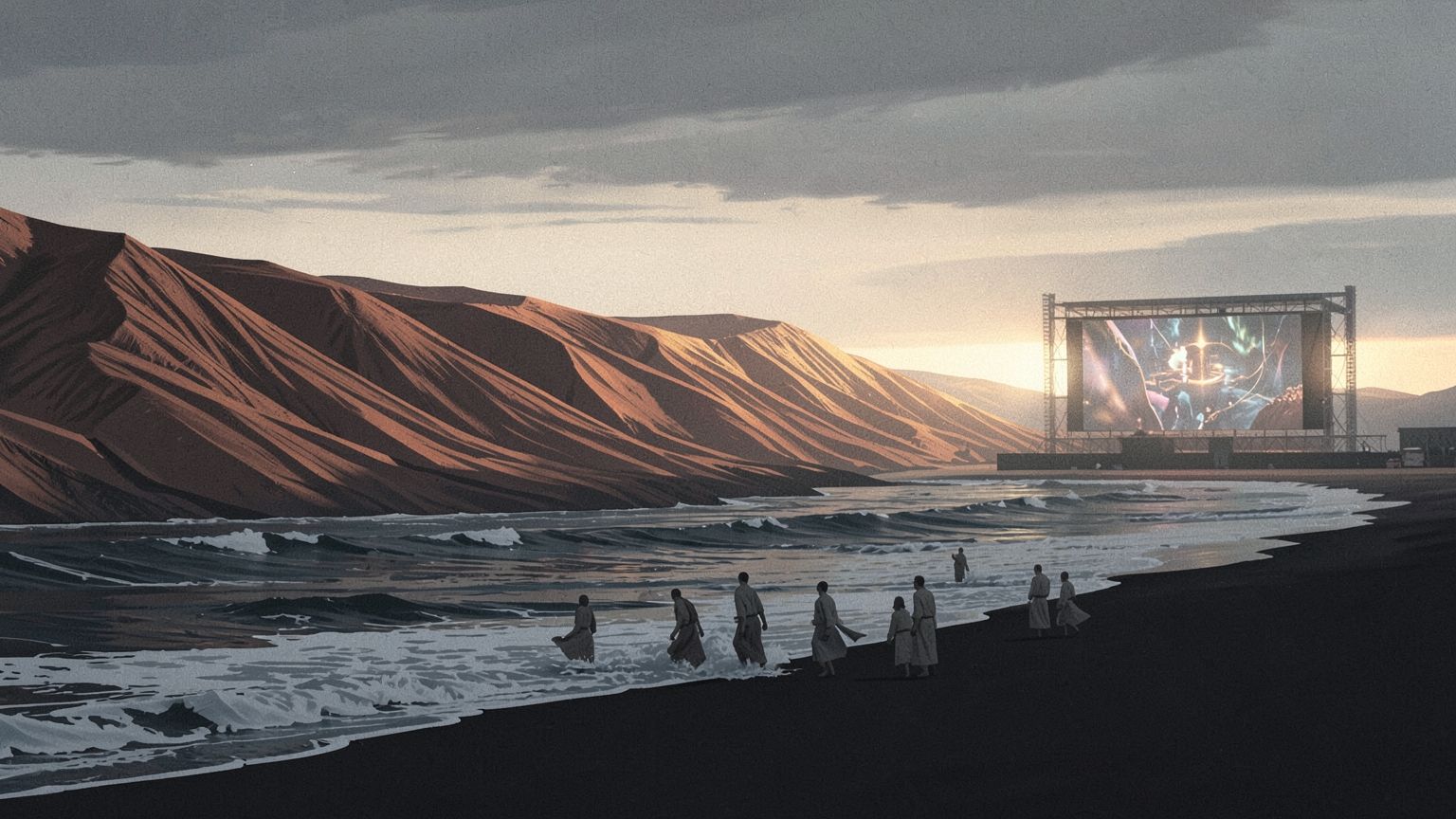
The Fremen in Dune: Part Three land on a wet planet, win a battle, and then run across black sand into the sea. That sequence was shot on an Icelandic beach that, by the account of the film's own location crew, no production had ever filmed on before.
The site is Ingólfshöfði, a nature reserve on a cape roughly 250 feet tall where puffin tours run in summer. Denis Villeneuve wanted a flat black plain running out of sight, low clouds and a strip of sunlight at the horizon. "Because of the black sand, we thought, obviously, Iceland," production designer Patrice Vermette told Condé Nast Traveler. The crew also weighed the Canary Islands. Location manager Duncan Broadfoot said the beach's unshot status helped settle it: "it's never been shot on before, so that was also an appealing aspect."
Dune: Part Three opens Dec. 18, 2026, closing the trilogy Villeneuve began with his 2021 adaptation of Frank Herbert's 1965 novel. What the crew is now describing is how the finale was assembled: that Icelandic beach, the UAE's Liwa Desert and a mountain near Al Ain, a Norwegian coast, and stages in Budapest, including what Vermette calls the largest LED screen wall of its kind ever built.
Getting this far was the unlikely part. David Lynch called his 1984 version "a huge, gigantic sadness" in his life, and Alejandro Jodorowsky's extravagant attempt never escaped development. Villeneuve's first two films did, and Part Two won the Academy Awards for sound and visual effects.
Twenty locations for one planet
Arrakis still comes mostly from the United Arab Emirates. Twenty separate sites in the Liwa Desert, near the Saudi border, were stitched together for this film, continuing a stand-in the crew has used since the first. Linus Sandgren, the cinematographer, described dunes of copper and beige sand whose ripple patterns the wind redraws every night.
The conditions were as punishing as the footage suggests. Temperatures reached 120 degrees Fahrenheit, and the crew based itself even deeper in the desert this time. Broadfoot said the third film had to go deeper and farther into the desert than the second had.
Some Arrakis scenes were instead shot around Al Ain, the UAE's "Garden City," including on Jebel Hafeet, the only real mountain in the area. Broadfoot said the crew scouted the entire mountain before settling on a high plateau with the craggy scale they wanted. On screen the area does double duty: it is the site of Alia Atreides's private Golgotha, where Paul's younger sister crucifies traitors, and the ground where Chani plays with her young children.
That pairing says a lot about how far the story has moved. Alia is grown and punishing traitors to the regime; Chani is a mother. The scenes fit the long-expected plan to adapt Dune Messiah, Herbert's follow-up, rather than stop where the first novel ends.
Not all of it is outdoors. The opening battle on Enfeil was largely built on the backlot at Waberer, one of four Budapest facilities the production used. There Villeneuve and Sandgren put up a 65-foot-tall, roughly 470-foot-long LED wall, which Vermette said was the biggest of its kind ever built. The shoot was big enough that the crew brought in cranes to move props and equipment through the airspace around the production.
Caladan, the Atreides home world, returns in brief flashes, shot as in the earlier films along the Kråkenes coast of northwestern Norway, where green cliffs fall into the Norwegian Sea. Vermette hid the location inside Arrakis: a single Norwegian pine stands in the courtyard of Alia's meditation room. "The only pine tree in all of Arrakis is right there," he said.
The appeal of all this is texture. Villeneuve's Dune has looked like a place a person could stand in, and that physical weight is a large part of why the films have landed. A black beach nobody had used and a dune field that rearranges itself overnight are decent evidence the money went on the screen.
The LED wall is the less romantic half of the same story, and the more revealing one. A screen that size is a major technical undertaking. The trilogy has escalated with each installment — farther into the desert, onto a protected reserve, under a bigger artificial sky — and escalation is a risk as much as a selling point.
The film arrives Dec. 18 with a story that has clearly jumped years beyond Part Two. Whether the trilogy finishes as solidly as it has been built is what the release will settle. Vermette's summary of the method is blunter. "If it was easy, I don't think we'd want to make them," he said.
Sources
Nina Patel
Nina Patel covers film, from release announcements and festival lineups to the changing ways audiences watch movies. Her coverage follows upcoming titles, production developments, and the wider conversation around cinema. She pays attention to release details and creative context, helping readers navigate a crowded calendar of films and screen events.
View all stories