SS United States, the fastest ocean liner ever, heads to the seafloor as a reef
After decades of failed rescue plans, the 1952 speed champion is slated to become the world's largest artificial reef off Destin, Florida.
 By Priya Desai
· 5 min read
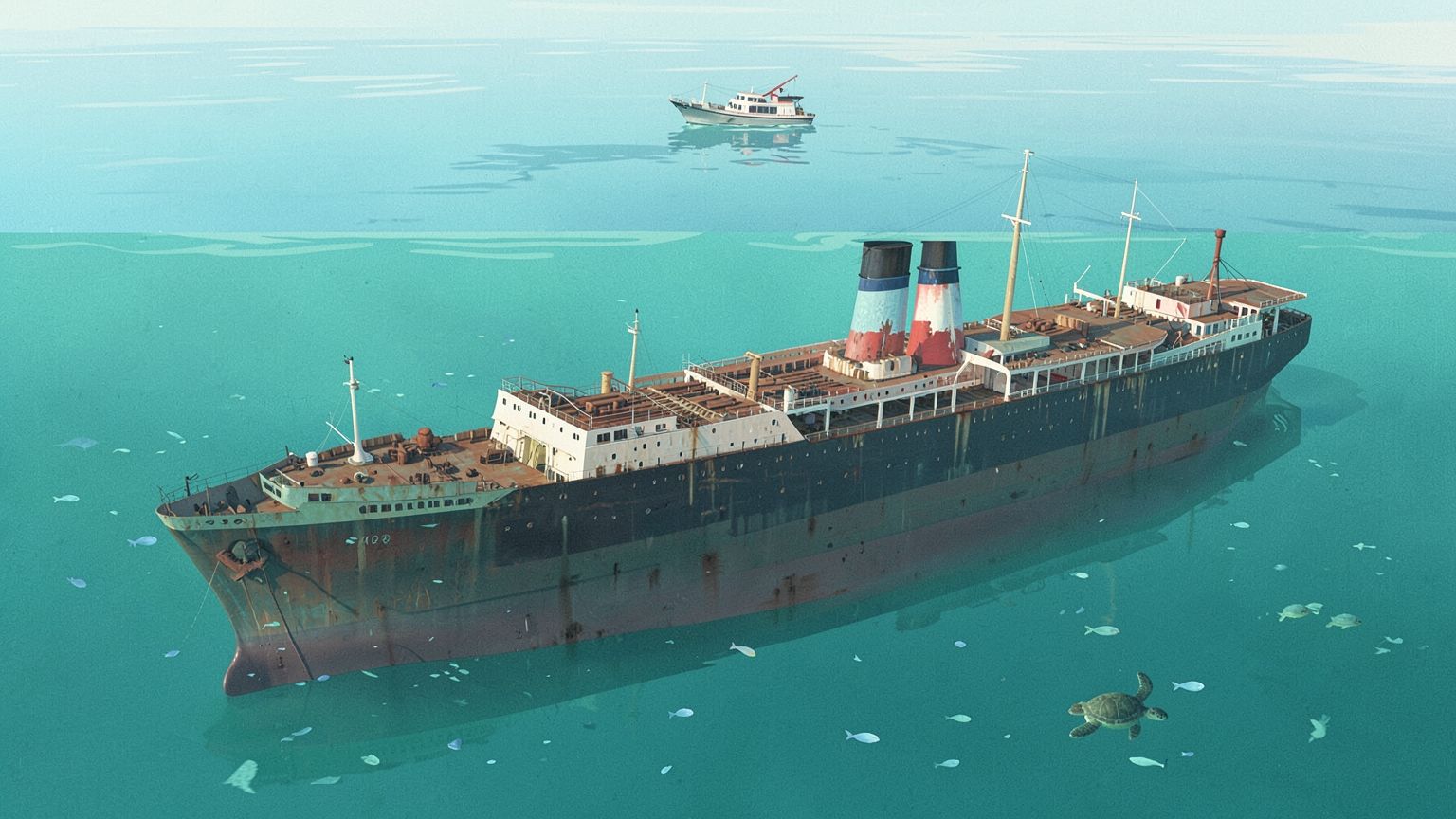
The SS United States, the American liner that still holds the record for the fastest transatlantic crossing by an ocean liner, was scheduled to be sunk off the coast of Destin, Florida, on Nov. 12. Its new job is to become the world's largest artificial reef.
The sinking settles a question that has hung over the ship since its last passenger voyage in November 1969. For nearly six decades it passed from one owner to the next while rescue plans came and went. It will not end up as a floating hotel or in a scrapyard. It is going to fish, sea turtles and recreational divers.
Measured against the realistic alternatives, that looks like the right call. It is also final in a way no earlier plan was. Once the hull settles on the bottom, no developer can step in later with a better idea.
At nearly 1,000 feet, the ship was the largest ocean liner ever built entirely in the United States when it was completed in the early 1950s. It ran 100 feet longer than the Titanic and had five more decks. Its designer, naval architect William Francis Gibbs, built it for speed. On its maiden voyage in July 1952, it crossed from New York to the United Kingdom in 3 days, 10 hours and 40 minutes, a mark no liner has beaten since.
Its passenger lists matched the speed. Marilyn Monroe, Salvador Dalí and Marlon Brando sailed on it, as did Harry Truman, Dwight Eisenhower and Eleanor Roosevelt.
The end came abruptly. Crew members stepping off the ship after its 400th voyage in November 1969 were told there would be no 401st. Cheap jet travel, rising fuel and labor costs, and the loss of government subsidies had made the liner unprofitable after only 17 years of passenger service.
The project belongs to Alex Fogg, natural resources chief for Destin-Fort Walton Beach's tourism agency. The waters off that stretch of the Florida Panhandle have little natural reef. Without one, marine life has fewer places to gather and breed. Artificial structures can fill that gap. Since 2017, more than 600 of them have gone down in the area, from small concrete blocks to whole ships, which has expanded local diving and fishing.
Fogg wanted a showpiece vessel for that program. A contractor told him the SS United States needed a new home, and he looked it up online. "I was like, 'Man, I really want that,'" he told Condé Nast Traveler.
The logic holds up. A wreck of this size, with this history, gives divers a reason to plan a trip around Destin rather than just stopping there. Tying the ship's preservation to a tourism budget may also prove sturdier than the private redevelopment deals that kept falling apart.
Those deals were the conservancy's first choice. The ship had sat for years in Philadelphia under the care of the SS United States Conservancy, a nonprofit. Some of its officers and board members had family or personal ties to the liner, and Fogg said sinking it was "not their number one choice." The group had hoped a developer would restore it. A plan to turn it into a recreation destination at Pier 76 in Manhattan was among the proposals that collapsed.
Board member Warren Jones sailed on the ship in 1961 and 1962, when he was 8. He remembers racing through the first-class ballroom with his sister and watching Disney films in the onboard theater. He said the reef plan beat the alternatives: "She's not being scrapped, and she's not just deteriorating at some pier somewhere." He also called his feelings "bittersweet."
After it was sold to the reef project, the ship needed a detailed survey and long talks with the Coast Guard before it could leave Philadelphia. It reached Mobile, Alabama, in March 2025 for environmental cleanup. Workers had already removed the asbestos cabin walls years earlier. A specialized crew still spent most of a year cleaning about 120 fuel tanks, scraping off loose paint, hauling out debris, tearing out the ventilation system and disposing of toxic materials.
Crews also removed the ship's 12 elevators. They were coated in grease, and the empty shafts give trapped air a path out. Fogg said a ship has to flood fast and vent fast to go down cleanly. "If not, it'll weeble-wobble and could potentially end up on its side," he said.
Explosives were once the standard way to scuttle a ship. This one was to be flooded instead, by opening valves connected to large, disconnected boiler pipes. A naval architect on the project estimated the hull would be fully underwater about 45 minutes after the valves opened. A flooding plan built on engineering estimates is a careful way to handle a hull this large, because a ship that lands at an angle is a weaker reef and a harder dive.
Condé Nast Traveler toured the stripped interior this summer. Its report described the outlines of first-class cabins still etched into the metal floors, empty lounges, the captain's dining room, a huge anchor on the bow and a maze of catwalks in the engine room. All of that will now be underwater.
Fogg said he and a small team planned to dive the wreck on the day of the sinking. They would check how it settled and retrieve the IMAX cameras mounted to film the descent. He expected recreational divers to arrive the next day. Fish should find the wreck within hours, he said, but the full ecosystem will likely take at least a year to develop.
A visitor center and a land-based museum are also planned, using artifacts and records the conservancy saved. No opening dates have been given. Those sites matter more than they might seem. Divers will get the steel, but most people who loved this ship will never strap on a tank. Whether its story stays visible to them now depends on what gets built on shore.
Sources
Priya Desai
Priya Desai covers everyday design, household objects, and the spaces where daily routines take place. Her work explores how materials, form, and function influence the things people use. She follows new products and design ideas with an emphasis on clear explanations, practical considerations, and the connection between thoughtful design and ordinary life.
View all stories